

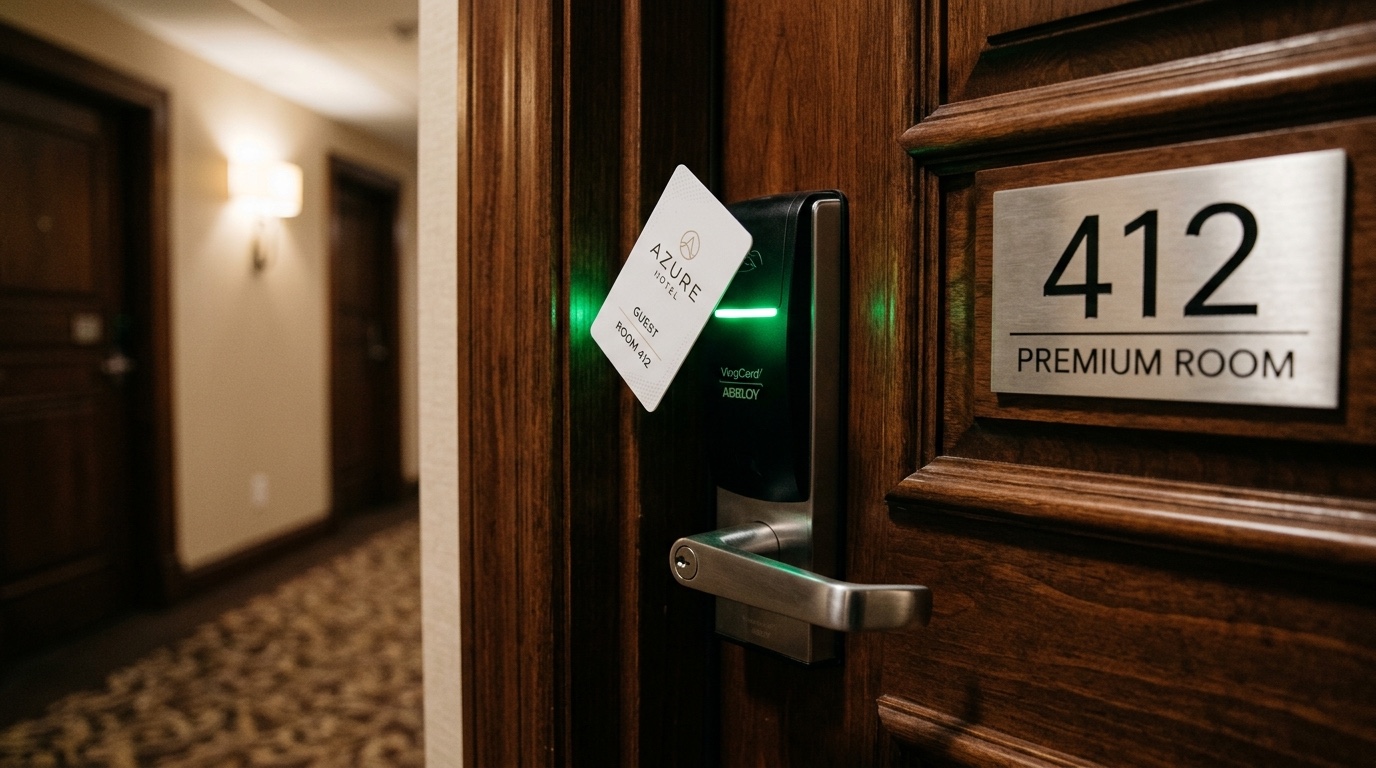
The guest has checked in online. The payment is complete. The room is ready. Unfortunately, those three facts live in three different systems, and reception knows only one of them.
Two numbers explain why this keeps happening in Thailand specifically. LINE reached 56 million monthly active users in Thailand by late 2025—78.2% of the entire population, according to DataReportal's Digital 2026 report—so it is very likely your guest's preferred messaging channel already. And Bank of Thailand data shows PromptPay alone processed roughly 2.53 billion transactions worth close to 4.66 trillion baht in May 2026. Your guests are already living inside a handful of always-on digital channels; the question is whether your hotel's systems agree on what those channels are telling you.
It sounds like an API integration project—connect system A to system B, done. It is actually a legal-sounding but very practical question: at each moment of the arrival event, which single system is allowed to say "this is true"? Get that wrong and every extra connection just gives two databases a faster way to disagree.
This guide walks through an eight-step arrival event, how to integrate the PMS, smart locks, payments, and LINE without creating a second source of truth, and what to monitor before you launch. That saved time is also the foundation of your self-check-in ROI calculation—integration determines whether the time is actually captured or lost to reconciliation.
Integration is not moving data everywhere. It is moving the right status to the next responsible person.
Status Custody: one system owns each fact, at each moment
Before discussing APIs, agree on ownership. Which system owns the guest name and reservation number? Where is room readiness confirmed? Which system records payment status? Who can override a mismatch? Where can staff see incomplete steps and exceptions?
Call this Status Custody: at any given point in the arrival journey, exactly one system should be the custodian of a given fact, and every other system should be reading a copy, not maintaining a competing original. If two systems can both silently overwrite the same field, the integration hasn't connected anything—it has just created a polite, ongoing argument between databases that nobody notices until a guest is standing at the desk holding the losing answer.
For most hotels, the property management system (PMS) should remain the main record for reservations, room assignment and arrival status. Self-check-in should read what it needs, collect what is missing, and return validated updates—never quietly maintain its own parallel version of a reservation.
Map the complete arrival event in eight steps
A useful flow often looks like this:
- The PMS supplies reservation details and expected arrival.
- The guest receives a secure check-in link through the approved channel.
- The guest confirms details, privacy information and required policies.
- Payment or deposit status is checked through the payment provider.
- Staff review any identity, payment or room exception.
- The lock system creates a PIN, digital key or card instruction only when conditions are met.
- The PMS records the completed or assisted arrival.
- Staff and guest receive the right confirmation.
Steps 3 and 6 touch personal data directly, so pair this blueprint with a PDPA, passport data, and TM30 checklist for digital check-in before you finalize the flow.
Draw this as a sequence with success, failure and manual fallback paths for each of the eight steps. "Send data to PMS" is not enough detail. State which data, when, after which validation, and what happens when the PMS is unavailable.
PMS integration: read less, write carefully
Use stable reservation identifiers rather than guest names as the main match. Names change format, contain spaces and appear differently across booking channels.
The self-check-in service may need to read reservation status, stay dates, guest count, balance, assigned room and room readiness. It may write confirmed contact information, arrival completion and operational notes. Apply three controls: idempotency, so retrying the same event doesn't create duplicates; audit history, recording what changed, when, and by which system or staff member; and an exception queue, so mismatches get an owner instead of being silently discarded.
Smart locks: issue access only after clear conditions
Different lock systems support PINs, mobile keys, encoded cards or limited integration. Verify the actual model and firmware, not only the lock brand.
Define the access rule explicitly—for example: reservation matched, identity step complete, payment condition satisfied, room assigned and check-in window open. Then decide how access is revoked after checkout and what staff do during internet, battery or lock-service failure. Never let a friendly message such as "Your room is ready" become the only evidence that access was created successfully.
Payments: separate status from assumption
Thai guests may expect card, bank transfer, PromptPay or Thai QR Payment depending on the property and booking route. The Bank of Thailand describes PromptPay as national payment infrastructure and includes Thai QR Payment among its service extensions. Bank of Thailand: PromptPay With transaction volume at the scale it now runs at nationally, your payment provider—not a screenshot uploaded by a guest—should confirm a digital transaction where possible.
Record payment references, amount, currency, status and time. Avoid storing sensitive card data in the check-in system unless there is a verified business and security requirement.
LINE: communication channel, not master database
With LINE reaching such a large share of the population, it's a natural channel for reminders, secure links and support handoffs—but it should stay a channel, not the system of record. To use the Messaging API, LINE requires a LINE Official Account with the Messaging API enabled. LINE Developers: Get started with the Messaging API Every time a user adds your account as a friend or sends it a message, LINE sends an HTTP POST request with a webhook event object to the webhook URL you register. LINE Developers: Receiving messages
Do not place passport data or access secrets directly into ordinary chat messages. Send a short-lived secure link instead. Keep consent and profile-access limits in mind: LINE documents that accessing a user's profile information requires the user's consent, and profile data isn't accessible for users who only use LINE for PC. LINE Developers: User consent
Use LINE for timed pre-arrival reminders, a secure check-in link, confirmation that a step is complete, and a clear route to human support. Keep the PMS or customer platform responsible for reservation context and ownership.
Build monitoring before launch
Track delivery failure, expired links, PMS timeouts, duplicate events, payment mismatches, lock-creation failures and the age of unresolved exceptions. Staff need one simple operational view, not four vendor dashboards.
Picture a hypothetical 36-room boutique hotel in Hua Hin called Baan Rak Talay—a fictional property used only as an illustration. In its first month of connecting mobile check-in to its PMS and smart locks, Baan Rak Talay found that of roughly 40 digital arrivals a week, about 3 produced a status mismatch: the lock system reported "key issued" while the PMS still showed the room as unassigned, because the two events had fired within the same two-second window and one message arrived out of order. The fix wasn't a bigger integration—it was a rule that the PMS's room-assignment status is the sole custodian of that fact, and the lock system must confirm it before issuing a key rather than acting on its own copy.
Launch with a limited room group or booking source. Run the digital flow beside the existing process, reconcile the records daily and remove the parallel work only after accuracy is proven. Across ASEAN, reuse the integration pattern but localize payment providers, messaging channels, identity steps and regulatory duties by country.
The Status Custody Playbook
- One Owner, One Fact — name the single system responsible for each field before writing a single line of integration; Baan Rak Talay's lock-versus-PMS mismatch existed because nobody had.
- Confirm Before You Act — a system should never issue a key, a receipt, or a confirmation based on its own guess; it should check the current custodian's status first.
- Log Every Handoff — an audit trail of what changed, when, and by which system turns a mystery mismatch into a two-minute investigation.
- Extend Custody Beyond the Front Desk — the same discipline applies anywhere two systems can update the same fact; a spa that lets guests book online and walk in both must agree on which system is the custodian of "this slot is taken," or the same overlap that hits hotel rooms will hit treatment rooms.
Custody: the one word this comes down to
If there's one word for what makes an integration actually work, it's Custody—not the number of systems connected, just a clear answer, for every fact that matters, about who is allowed to say it's true.
So here's the question worth sitting with: pick any one fact your arrival flow depends on—room readiness, payment status, key issuance—and ask who currently owns it. If more than one system could answer "me," that's where your next silent mismatch is already forming.
Frequently asked questions
Do we need to replace our PMS to integrate self-check-in?
Usually not. Most integrations connect a self-check-in layer to your existing PMS rather than replacing it—the PMS typically stays the custodian of the reservation record.
What happens if the internet or PMS goes down mid-check-in?
That's exactly what step-by-step failure and fallback paths are for. Define, in advance, what staff do manually when each system is unavailable, rather than discovering it during an outage.
Is LINE secure enough to send check-in links?
LINE itself is a widely used, encrypted messaging channel, but the security of your flow depends on sending short-lived, single-use links rather than raw personal data through chat messages.
How do we know if our integration is actually saving time?
Reconcile the digital and manual processes daily during a pilot and track exceptions, not just completions—a high completion rate can hide a growing pile of unresolved mismatches.
Should smaller independent hotels attempt all of this at once?
No. Start with the PMS and one other system—usually payments or locks—prove Status Custody works for that pair, then add the next connection.
Not sure where to start? NAWA's hotel self-check-in product is built around exactly this integration map—PMS, payments, identity, messaging, and room access connected to one guest journey instead of five separate ones. Talk to us about your current systems and we'll help you map a clear system-of-record plan before you choose vendors.
Sources reviewed
- DataReportal: Digital 2026 Thailand
- Bank of Thailand: PromptPay transaction statistics
- Bank of Thailand: PromptPay overview
- LINE Developers: Get started with the Messaging API
- LINE Developers: Receiving messages (webhook)
- LINE Developers: Consent on profile information
Information and links were reviewed on 12 August 2026.