

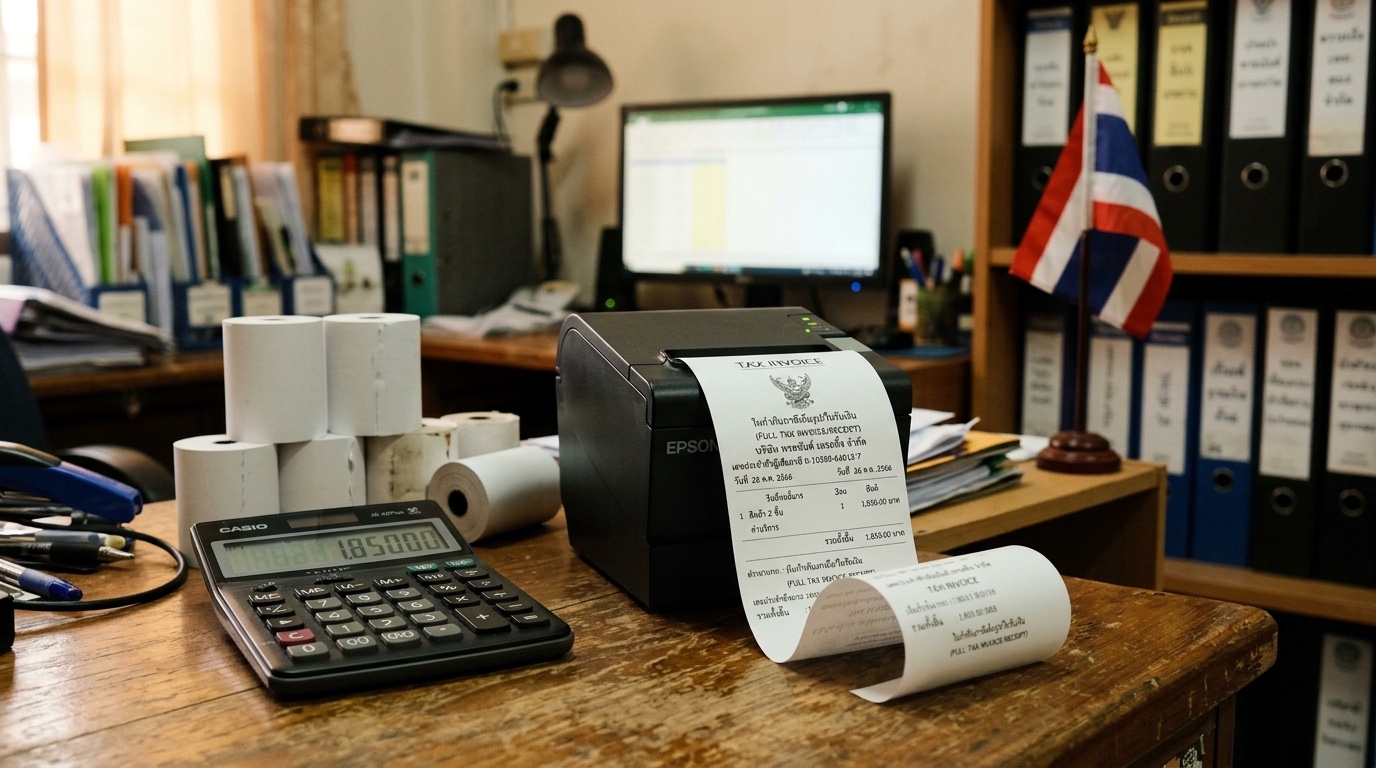
A finance manager reads that Cabinet has approved a 200% tax deduction for e-Tax Invoice spending and assumes it means the deadline finally arrived — buy the software, tick the compliance box, done. Then the accountant points out something less convenient: e-Tax Invoice is still voluntary in Thailand, with no legislated B2B mandate for 2026 or 2027. The incentive isn't a deadline. It's an invitation, and the business still has to decide whether its data is actually ready to accept it.
Thailand's Cabinet approved the current package on 16 June 2026: a flat 1% e-Withholding tax rate and a 200% deduction on qualifying e-Tax Invoice, e-Receipt, and e-Withholding system expenses, both extended through 31 December 2027. Smaller businesses have an easier on-ramp too — the simplified e-Tax Invoice by Email route stays open to businesses with revenue up to THB 30 million, without requiring the full structured-XML setup.
It sounds like a tax-compliance decision. It's actually a data-matching decision: the incentive rewards businesses whose invoice, payment, and receipt can already be reliably matched by reference — not businesses who simply bought e-Tax software and converted a PDF. Converting a paper invoice into a PDF was never the hard part. Matching it to the right payment reliably is.
Digital documents work when the business event, master data, approval, and payment reference agree.
This piece covers what the Revenue Department's e-Tax system and the Bank of Thailand's PromptBiz infrastructure actually connect, what "ERP-ready" means separately from "your bank or provider is ready," and a practical checklist for testing the cases that usually break first.
Understand the Official Landscape Before You Commit
Thailand's Revenue Department operates the e-Tax Invoice and e-Receipt service, covering registration, document-structure validation, and host-to-host submission — participation remains voluntary, with no revenue threshold forcing adoption, though the simplified email-based route is capped at THB 30 million in annual revenue for businesses that don't need the full XML integration. Verify current eligibility and technical requirements directly with the Revenue Department and your tax adviser before committing to either route.
The Bank of Thailand's PromptBiz is a unified, ISO 20022-based infrastructure for cross-bank transmission of trade and payment data — connecting e-invoices, e-receipts, e-tax invoices, bulk payment transfers, and supply-chain financing so that payment information can be matched back to the invoice it actually belongs to. Its first phase launched on 29 August 2023, with pilot banks including KTB, BBL, BAY, KBANK, and TTB. Smaller businesses building toward this can also look at OSMEP's Business Development Service subsidy, which co-funds 50–80% of eligible technology and business-development costs depending on enterprise size (capped between THB 50,000 and 200,000 a year), and DEPA's mini transformation voucher, worth up to THB 10,000.
The Reference Match: Why a PDF Invoice Isn't a Connected One
Call it the Reference Match: the specific, unglamorous requirement that an invoice, a payment, and a receipt can be reliably tied together by a stable reference number — not eyeballed by a human comparing a bank statement to a folder of PDFs. This is what separates a business that has "gone digital" from one that has actually built connected operations, and it's also, not coincidentally, exactly what the 200% deduction and PromptBiz infrastructure are built to reward and support.
Picture a hypothetical company called Siam Packaging, a fictional B2B supplier of boxes and packaging materials to manufacturers. Siam Packaging switched to issuing e-Tax invoices as PDFs early, proud of going paperless. Six months later, its finance team still spent two days every month manually matching bank transfers to invoices, because the payment reference a customer typed into their banking app rarely matched the invoice number Siam Packaging had issued — and a partial payment, or two invoices settled in one transfer, broke the match completely. Nothing about this was a PromptBiz problem or a Revenue Department problem. It was a Reference Match problem: Siam Packaging had digitized the document without designing the data that would let a payment find its invoice automatically.
Prepare Master Data and Map Document States
Clean legal entity details, tax IDs, addresses, branches, customer and supplier records, product and tax codes, bank references, and document numbering, and decide exactly who is allowed to change each field. Then define every state a document can be in — draft, approved, issued, delivered, corrected, cancelled, paid, and receipted — and record precisely which event triggers the next document, and how a failure gets recovered rather than quietly re-keyed by hand.
Connect Payment Reconciliation Without Guessing
Use stable, consistent invoice and payment references from day one, and design explicitly for partial payments, combined payments, short payments, and overpayments — these are the normal cases that break a naive one-to-one match, not the exception. Never mark an invoice paid from a screenshot when a verified bank or provider status is actually available; a screenshot is evidence someone saw a number, not proof the system agrees with it.
Separate ERP Readiness From Provider Readiness
Your ERP may already be technically capable of producing well-structured data while your bank, service provider, or the tax method you've chosen still has its own separate enrolment, format, and operational conditions to satisfy — confirm the current service path with each official provider directly rather than assuming your software vendor has already handled it. If you haven't yet confirmed ERP is the right investment at all, it's worth revisiting the seven operational signs that mean Excel and LINE have run out of road before adding e-Tax and PromptBiz scope on top of an unresolved coordination problem.
Don't promise automatic PromptBiz or Revenue Department integration just because a product brochure uses the word "API." Verify the actual scope, any applicable certification, supported document types, error handling, and who's responsible when a submission fails.
Assign Ownership Before You Automate Anything
Finance should own the tax and reconciliation rules. Operations should own the underlying business event. Technology should own reliable transmission and monitoring. Management resolves policy and exception authority when the three disagree. If it's genuinely unclear whether tax and reconciliation duties belong in ERP, accounting software, or a CRM add-on, it's worth comparing what each system is actually built to own before assigning permanent responsibility to the wrong one. Build a simple dashboard for documents waiting on approval, rejected validation, unmatched payments, and receipts not yet issued, and give each queue a named owner and an ageing target.
Test the Uncomfortable Cases, Then Measure Honestly
Include credit notes, cancelled invoices, partial payments, deposits, withholding tax, branch-level detail, foreign currency, customer master-data changes, and failed submissions in your testing — these uncomfortable cases, not the clean example, are what actually determine whether the system works. Reconcile the digital document, the ERP transaction, the accounting entry, and the payment reference together, not separately.
Track manual entry, unmatched payments, document correction, billing-to-payment time, and days to close, and count the reduction in paper and manual handling honestly — but don't claim compliance savings before the process has actually been through an audit. Start with one legal entity, one customer group, and a manageable document type, and run parallel reconciliation until totals and exceptions are genuinely trusted, not just quiet.
The Reference Match Playbook
- Stable Reference, Every Time — every invoice and payment carries a reference number that survives partial payments, combined settlements, and corrections without breaking.
- No Screenshot Approvals — a payment only counts as confirmed when a verified bank or provider status says so, never a forwarded image someone glanced at.
- One Uncomfortable Case a Week — during rollout, deliberately test one difficult scenario weekly (a credit note, a foreign-currency payment, a partial settlement) instead of assuming the easy cases prove the system works.
- Cross-Industry Check — a professional services firm billing hourly retainers faces the identical Reference Match problem the moment a client pays a partial invoice against three months of outstanding fees; the fix is the same discipline, not accounting-specific software.
Match: What This Actually Comes Down To
If there's one word for what actually makes e-Tax Invoice and PromptBiz work for a business, it's Match — not whether you've digitized a document, but whether that document, its payment, and its receipt can find each other automatically, every time, without a human comparing two screens by hand.
Here's a fair question to sit with: pick one payment that came in this week and try to trace it back to its invoice using only your current system, with no phone calls and no manual searching. If that takes longer than it should, the gap isn't your tax compliance — it's the Reference Match, and it's worth fixing before you chase any incentive built on top of it.
FAQ
Is e-Tax Invoice mandatory for Thai businesses in 2026?
No. As of 2026, participation remains voluntary, with no legislated B2B mandate for 2026 or 2027 — adoption is encouraged through tax incentives rather than required by threshold.
What exactly does the 200% deduction cover?
Companies and registered partnerships can deduct 200% of qualifying expenses on e-Tax Invoice, e-Receipt, and e-Withholding systems — including software, hardware, electronic storage, and fees paid to approved service providers — through 31 December 2027, per the Cabinet resolution of 16 June 2026.
Does having e-Tax Invoice automatically mean we're connected to PromptBiz?
No. They're related but separate: e-Tax Invoice is the Revenue Department's document system, while PromptBiz is the Bank of Thailand's payment and trade-document infrastructure. Confirm your bank's and provider's specific PromptBiz enrolment separately from your e-Tax setup.
What's the single biggest reason e-Tax and PromptBiz projects stall?
Assuming digitizing a document is the same as connecting it. The recurring bottleneck is the Reference Match — invoices, payments, and receipts that can't be reliably tied together without manual comparison.
If you're weighing whether your business is actually ready for e-Tax Invoice and PromptBiz, or your finance team is still matching payments by hand, request an ERP and digital-document readiness assessment from NAWA and we'll help map your data, approvals, and integration gaps before you commit.
Sources reviewed
- Revenue Department: e-Tax Invoice and e-Receipt
- Bank of Thailand: PromptBiz
- VATupdate: Thailand's e-Invoicing Remains Voluntary — 2026/2027 Updates and Tax Incentives
- HLB Thailand: Cabinet approves extension of tax measures to end of 2027
- Acclime: e-Withholding tax cut and digital tax incentives extended
- DEPA: Mini Transformation Voucher