

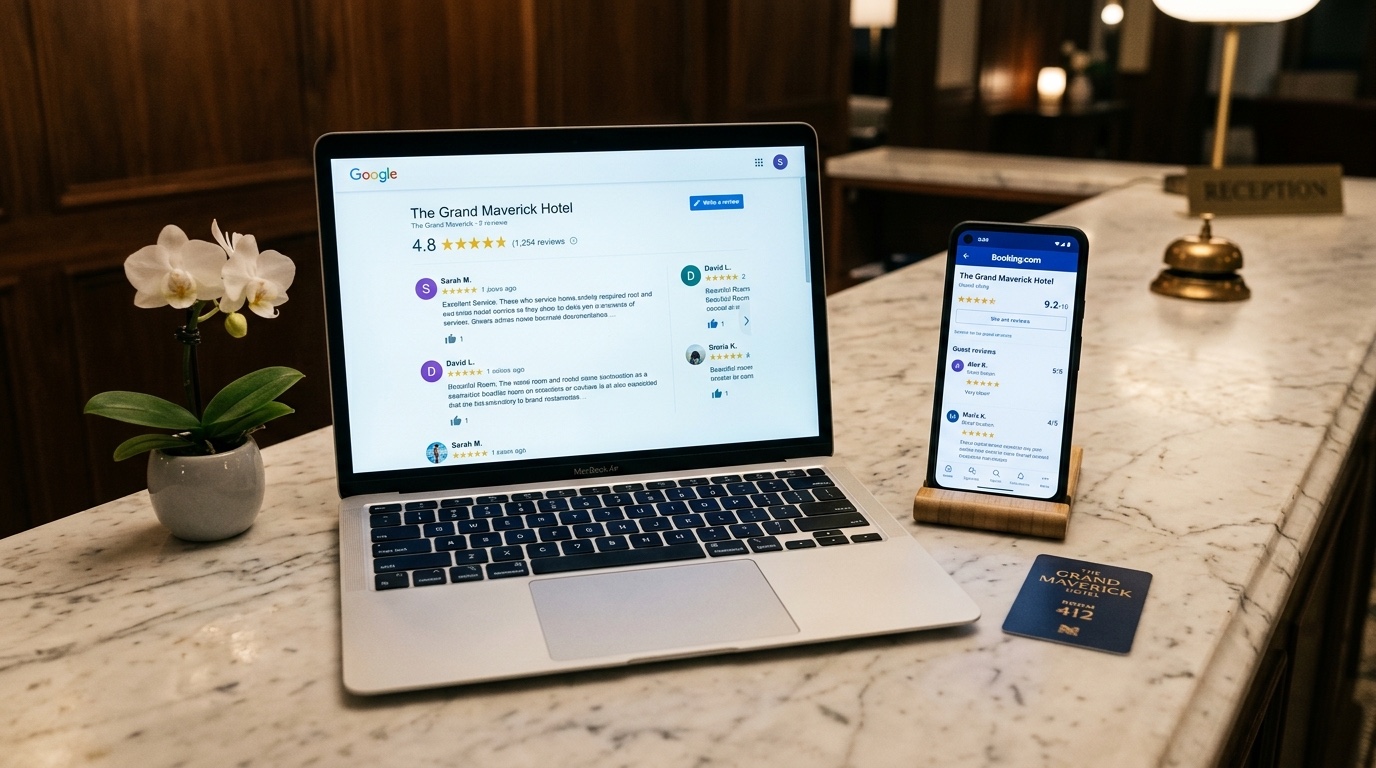
A hotel's weekly ops meeting spends ten minutes arguing about which number matters: the Google rating, which just dropped from 4.6 to 4.5, or the Booking.com score, which is holding steady at 8.9. Someone proposes fixing whichever one is lower. That's the wrong question.
BrightLocal's Local Consumer Review Survey 2025 found that 74% of consumers check two or more review websites before making a decision. Guests aren't picking one platform and trusting it blindly—most of them are cross-referencing. That sounds like it should make prioritizing harder, since now there are two scores to defend instead of one. Actually, it makes prioritizing easier, because Google and OTA reviews were never actually competing for the same moment in the guest's decision. They're doing two different jobs, and once you see which job is which, "which score matters more" stops being the right question.
This piece compares what Google reviews are actually for, what OTA reviews are actually for, and how to build one scorecard that respects the difference instead of averaging it away.
Google and OTA reviews aren't competing for the same guest at the same moment. Treat them as two different jobs, and you'll finally know which one to fix first.
Google supports discovery and local trust
Google reviews appear around Search and Maps, often before a guest has picked a booking channel at all. Google's own guidance states that "more reviews and positive ratings can help your business's local ranking," alongside relevance and distance. Google: Tips to improve your local ranking
Google therefore matters most for branded search, nearby discovery, restaurants and facilities used by non-staying visitors, and guests comparing the hotel against booking direct. It's the layer that decides whether you're in the consideration set at all.
The Discovery-Decision Split: why Google and OTA reviews are doing two different jobs
Call this the Discovery-Decision Split. Google reviews mostly influence discovery—whether a guest finds you, trusts you enough to click through, and considers you a real option. OTA reviews mostly influence the decision—whether a guest who has already narrowed the field to three or four properties picks yours.
That split explains why a hotel can have a strong Google score and still lose bookings to a competitor with a weaker one: the competitor's OTA reviews might simply be doing a better job at the decision stage, where rate, availability, and star rating for the exact room type all sit next to the review score. A hotel obsessing over its Google number while its Agoda listing quietly accumulates complaints about noise is optimizing the wrong half of the split.
OTA reviews sit close to a transaction
Agoda, Booking.com, and other online travel agencies place reviews beside rate, availability, and booking conditions. The reader has often already selected a destination and dates. A repeated comment about Wi-Fi, noise, or breakfast at that stage can change a booking decision within seconds, because there's no second visit to a search results page—the guest is choosing between the properties already in front of them.
OTA feedback also reflects the expectations created by that channel's own listing. An unclear room description or a vague facility label can create a reputation problem before the guest ever arrives.
Prioritize with four questions
- Which channel produces bookings or qualified direct traffic?
- Where are new reviews arriving fastest?
- Which themes have the greatest guest or revenue impact?
- Which listings contain expectation-setting errors?
Do not use one average across platforms. Compare theme, language, room type, source market, and period instead.
Picture a hypothetical property called Sai Fon Boutique Hotel—a fictional 24-room property in Chiang Mai used only as an illustration here. Sai Fon's Google rating sat at a healthy 4.7, so management assumed reputation was fine. Its Agoda score had quietly slipped to 8.4 over two months, driven by a repeated, specific complaint: the "mountain view" room category didn't actually show the mountain from the bed. Nobody had noticed, because nobody was checking the OTA-specific themes—only the headline Google number.
Use one response standard
Respond on the platform where the guest posted. Keep replies short, specific, and privacy-conscious—Google's own guidance for review replies emphasizes staying helpful and relevant while never sharing a reviewer's private information. Google: Manage customer reviews If your team needs a starting point rather than improvising tone under pressure, Thai and English templates for negative review responses can help your team sound human instead of scripted.
Create a central improvement queue so the same issue isn't "solved" independently by three people writing three separate apologies on three platforms.
Balance direct and public feedback
Ask all genuine guests for feedback without incentives or positive-review filtering. Give dissatisfied guests a real recovery channel, but never use it to prevent honest public reviews. For a Thai independent hotel, review weekly by channel and monthly across all channels. The most important review is often not the loudest one; it's the repeated operational signal the team can still fix.
Create a channel scorecard
For each platform, record new review count, average score, response time, top positive themes, top negative themes, and booking or traffic importance. Once the volume gets too large to tag by hand, AI can help surface recurring themes across languages and platforms. Add direct feedback so management can see issues recovered privately as well as those published publicly.
Weight action by severity and frequency rather than platform prestige. A rare complaint about an unclear sign may need a small fix. A repeated air-conditioning problem across several OTAs needs maintenance ownership even if the overall score remains high.
Correct expectations at the source
Some reputation problems are listing problems, not service problems. Compare repeated comments with room descriptions, photographs, facility hours, location wording, and booking conditions. If guests repeatedly expect a sea view from a room category that doesn't include one, the answer isn't a more elegant apology—it's correcting the listing before the next booking.
The Discovery-Decision Playbook
- Discovery Layer—own your Google presence for the guests who haven't chosen a booking channel yet: profile completeness, photos, and review count and score.
- Decision Layer—own your OTA listings for the guests already comparing three or four properties: accurate room descriptions and a fast, specific response to recent themes.
- Split Scorecard—track Google and each OTA separately, never as one blended average, so a problem hiding in one channel can't be masked by strength in another.
- Source-Market Weighting—a restaurant chain choosing between Google, LINE reviews, and a food-delivery app's rating faces the same split: one platform builds discovery, another sits at the point of ordering, and neither substitutes for the other.
Split: what it all comes down to
If there's one word for how to think about Google versus OTA reviews, it's Split—not which score is "real," but which job each one is doing for a guest who almost certainly checked more than one before deciding.
So here's a question worth sitting with: if you had to guess right now, without looking, whether your Google score or your best OTA score would surprise you more if you actually checked it today—which one would it be? That's the platform your scorecard has been quietly ignoring.
FAQ
Should a hotel prioritize Google or OTA reviews?
Neither, exclusively—prioritize whichever one is closer to where your actual guests are dropping off, discovery or final decision. Most hotels need both working, not one traded off against the other.
Why do so many guests check more than one platform?
BrightLocal's 2025 survey found 74% of consumers check two or more review sites before deciding, which suggests most guests treat a single score as one data point, not a verdict.
Does a high Google rating protect against a weak OTA score?
No. They influence different stages of the journey, so strength in one doesn't offset weakness in the other—a guest comparing properties on Agoda never sees your Google number in that moment.
How often should a hotel review its channel scorecard?
Weekly by channel is enough to catch an emerging theme before it compounds; monthly across all channels is enough to see whether the overall pattern is improving.
Can the same review response work on every platform?
The core facts should stay consistent—what was heard, why it mattered, what happens next, and where to follow up privately—but keep replies short enough to fit each platform's format and tone.
NAWA Trust owns the Google half of this split: it brings every Google Business Profile review, across every branch, into one inbox, drafts an on-brand AI reply for your team to approve, and tracks rating, response time, and recurring themes on one dashboard. It won't replace watching Agoda or Booking.com directly, but it keeps the discovery layer of your scorecard current without someone manually checking it every morning. Talk to us about your current workflow and we'll help you find the clearest place to start.
Sources reviewed
- BrightLocal: Local Consumer Review Survey 2025
- Google Business Profile: Tips to improve your local ranking
- Google Business Profile: Manage customer reviews