

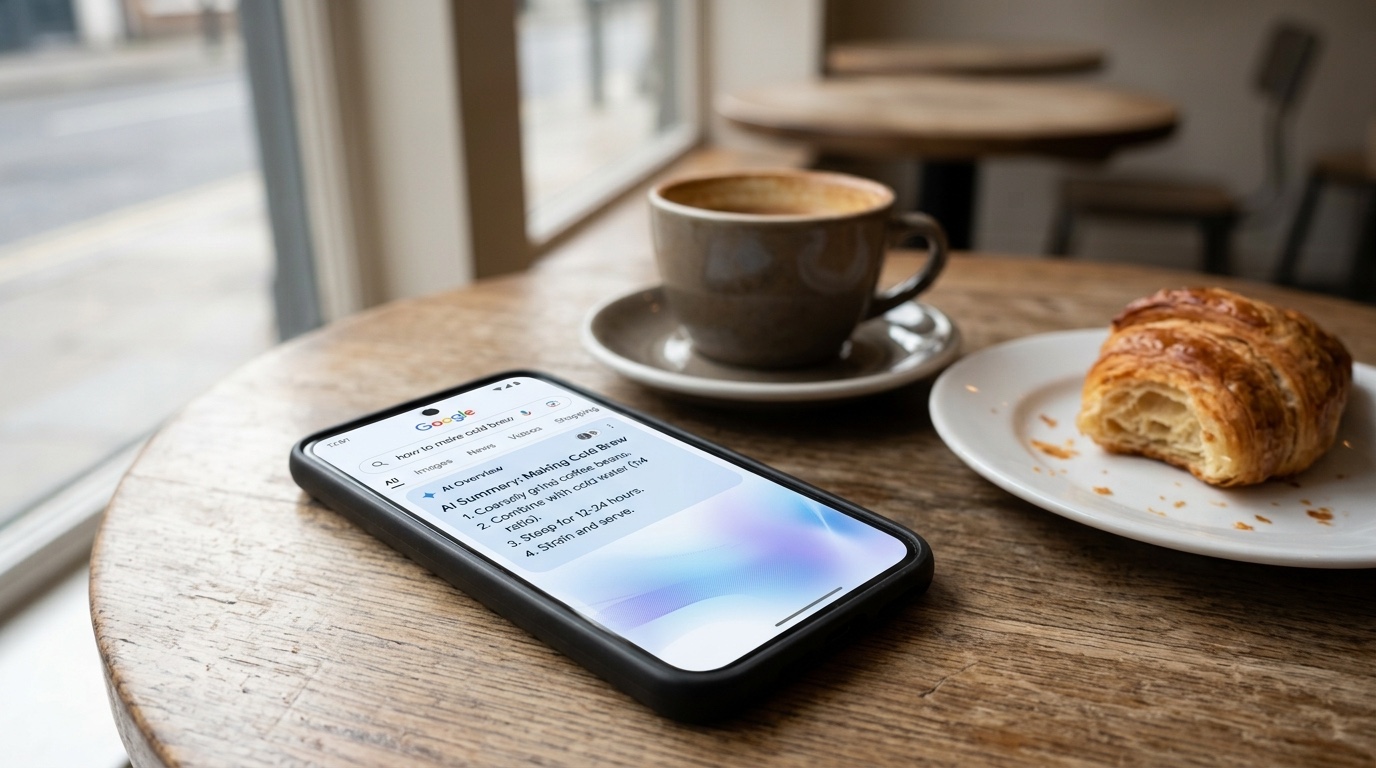
A customer types a full question into Google—"โรงแรมเปิดให้เช็คอินกี่โมง"—and gets a summarized answer sitting above the results, sourced and synthesized, before a single blue link is clicked. Multiply that by millions of searches a day and you land on the number that's been repeated in nearly every marketing meeting this year: 68.01% of Google searches ended without a click between January and April 2026, up from 60.45% just two years earlier, according to SparkToro's analysis of Similarweb panel data. Marketers took that number and told a familiar story—AI ate search, SEO is dead, stop investing in it.
It sounds like an obituary for organic search. It isn't, and the reason matters more for a Thai business than the headline number itself. That 68% figure comes from a US desktop-and-mobile panel—there is no equivalent public zero-click study for Thailand yet—but the underlying shift it measures is the same one already reshaping where Thai search traffic goes, and the Thailand-specific numbers on that are sharper and more useful than the global headline. This piece separates what the zero-click number actually says from what it's been made to mean, walks through what's actually happening to search behavior inside Thailand right now, and lays out what it changes about how a website earns a visit at all.
A rising zero-click rate doesn't mean fewer people are searching—it means more of the answer happens before the click, so a website's job shifts from winning the ranking to earning the click that comes after the answer.
The Zero-Click Number, Read Correctly
SparkToro's analysis, covering January through April 2026, found 68.01% of Google searches in its US panel ended with no click to any website, up from 60.45% in 2024—a jump SparkToro describes as the fastest acceleration of the trend in the last decade. The research also found that when an AI Overview appears on a results page, which it now does on more than 20% of searches, it cuts click-through rate by nearly 60% compared to a results page without one.
Two things are true about this number at once. First, it's real and it's accelerating—AI-generated summaries are absorbing a growing share of searches that used to require a click to answer. Second, it's a US measurement, built from a US search panel, and Thailand doesn't have a directly comparable public study. Applying a US percentage to Thai search behavior would be exactly the kind of unsourced number this article is trying to avoid. What's useful instead is looking at what Thailand's own data says is actually happening here.
The Answer Tax: What Every Page Now Has to Earn Before the Click
Call it the Answer Tax—the fact that a piece of content now has to satisfy two audiences in sequence before it earns anything. First, an AI system has to judge the content worth summarizing or citing when it assembles an answer. Only after that does a human decide whether the summary was enough, or whether the question is worth a click-through for something the summary couldn't give them: an exact price for their specific case, current availability, a photo, a policy detail, or simply trust that the source is real.
This isn't a new toll on top of SEO—it's SEO's job description getting more precise. Google itself confirmed at its I/O 2026 keynote that AI Overviews had crossed 2.5 billion monthly active users, a scale covered in more detail in our earlier look at how SEO and GEO work together. At that scale, being the page an AI system chooses to cite is now a real form of visibility, even on searches that never turn into a click. The clicks that do still happen skew toward higher intent, because the searcher already has the basic fact and is clicking for something more specific to them—which is a different, arguably more valuable kind of visit than the old scroll-and-bounce traffic zero-click growth is replacing.
What's Actually Happening to Thai Search Traffic
Thailand had 67.8 million internet users as of October 2025, a 94.7% penetration rate against a population of 71.6 million, according to DataReportal's Digital 2026 Thailand report. Inside that base, AI-assisted search is growing fast but starting from a small base: weekly active users of ChatGPT in Thailand grew more than fourfold over the year to September 2025, reported Nation Thailand citing OpenAI's own data, with adults aged 18–24 identified as the primary driver of that growth.
But the platform breakdown matters as much as the growth rate. Primal, a Thailand-based digital marketing agency, published SimilarWeb data for April 2026 showing Thai monthly visits running at roughly 40 million for Gemini, 35 million for ChatGPT, 7 million for Bing, and 1 million for Perplexity—with Google's own ecosystem (Search, AI Overviews, and Gemini combined) capturing an estimated 96% of all Thai search and AI traffic. Read plainly, that means the "AI killed Google" narrative circulating out of the US doesn't map cleanly onto Thailand yet. The overwhelming majority of AI-assisted answers a Thai customer sees are still happening inside properties Google itself owns and feeds from the same crawlable web. The fundamentals that make a page visible to Google Search remain the single highest-leverage investment for a Thai business—ChatGPT's growth is real and worth watching, especially among younger customers, but it isn't yet where the volume is. We break down the full platform-by-platform picture, and what it means by business type, here.
Picture this: Talat Noi Coffee Roasters loses the click but keeps the customer
Picture a hypothetical business called Talat Noi Coffee Roasters, a small-batch coffee roaster and wholesale supplier in Bangkok. For two years, its blog on brewing methods and bean sourcing pulled steady organic traffic, and the owner measured success the old way: sessions, pageviews, time on page. Then a barista training academy called to place a wholesale order and mentioned, almost in passing, "we asked Google about specialty roasters near Talat Noi and your cupping process came up in the summary—is that accurate?" The owner checked the analytics for that exact search term. It showed almost no clicks. The AI answer had done the introducing entirely on its own; the website only had to hold up once someone actually asked to see it. Nothing about Talat Noi's content work had stopped working—it had simply stopped being visible in the metric the owner was used to watching.
The Answer Tax Playbook
- Cited-Not-Clicked Tracking — periodically ask the AI tools your customers use the exact questions they'd ask about your business, and note whether you're mentioned, since standard analytics won't show you this demand at all.
- Second-Question Content — build pages that answer the specific follow-up an AI summary can't fully resolve: exact pricing for a real scenario, current availability, a documented policy. That's the question that still earns a click. If your site already gets visits but few enquiries, this conversion checklist is the next place to look.
- Google-First Foundation — with Google's ecosystem still carrying the large majority of Thai search and AI-answer traffic, keep core SEO and Business Profile signals as the primary investment, not a legacy line item to trim.
- Second-Platform Watch — track fast-growing but still smaller channels like ChatGPT, particularly for younger customer segments, without diverting your main investment away from Google-first fundamentals yet.
A private tutoring center choosing which subjects to write detailed guides for faces the identical trade-off: build for the parent who wants a synthesized answer today, but also for the parent who clicks through next month to compare actual class times and prices.
Earned: what it all comes down to
If there's one word for what the zero-click trend actually changes, it's Earned—not that clicks disappeared, but that a click now has to be earned twice: once by the content being worth summarizing, and again by the page being worth visiting after the summary.
So here's the question worth sitting with: if you couldn't see a single pageview for the next month, but you could see every question an AI system answered using your business as a source, would you feel more or less confident about how visible you actually are?
FAQ
Is SEO actually dead in Thailand?
No. The core fundamentals of SEO—crawlable pages, clear content, accurate business information—are exactly what AI systems draw on to build their answers. What's changed is that ranking well is no longer the only form of visibility worth measuring; being cited in an AI-generated summary is now a parallel outcome.
Is the 68% zero-click figure specific to Thailand?
No. It comes from SparkToro's analysis of a US Similarweb search panel. There's no equivalent public zero-click study for Thailand yet. The Thailand-specific numbers in this article—internet penetration, ChatGPT growth, and the platform breakdown of Thai AI search traffic—come from separate, Thailand-specific sources.
Does this mean my website traffic will fall no matter what I do?
Not necessarily, and even where it does, traffic volume alone was never the right thing to optimize for. A smaller number of higher-intent visits, arriving after a customer has already gotten the basic facts elsewhere, can convert at a similar or better rate than a larger volume of low-intent browsing.
Which AI platform matters most for a Thai business right now?
Based on Thailand-specific traffic data, Google's own ecosystem—Search, AI Overviews, and Gemini combined—still captures the large majority of Thai search and AI traffic. ChatGPT is growing quickly, especially among younger users, but it's currently a smaller share of the total.
How do I know if my business is being cited in AI answers if I'm not getting the click?
Ask the AI tools directly. Type the exact questions a customer would ask about your business or industry into Google's AI Overview, ChatGPT, and similar tools, and note whether—and how accurately—you're mentioned.
Should I stop investing in content if fewer people click through to read it?
No. The same content is now doing two jobs: earning a citation in an AI answer, and earning a click for the reader who needs more than the summary. Cutting it removes both.
What this looks like with NAWA AI Websites
NAWA AI Websites builds the structured pages, metadata, schema, and internal linking that give both Google's crawlers and AI systems a clean, accurate version of your business to draw from—so the summary an AI generates about you is the one you'd actually choose. On the human side, we connect content and conversion decisions to real visitor behavior, so you can see which pages are still earning the click, not just which ones used to.
If you're not sure whether your site is set up to be cited accurately by AI search tools, or whether the traffic you're seeing tells the whole story, talk to us about an AI website and search visibility review.
Sources: SparkToro, "In 2026, Less than One Third of Google Searches Still Send a Click"; Primal, "How Thai Brands Win AI Search in 2026" (SimilarWeb data, April 2026); DataReportal, "Digital 2026: Thailand"; Nation Thailand, reporting on OpenAI data; Google, Sundar Pichai's I/O 2026 keynote