

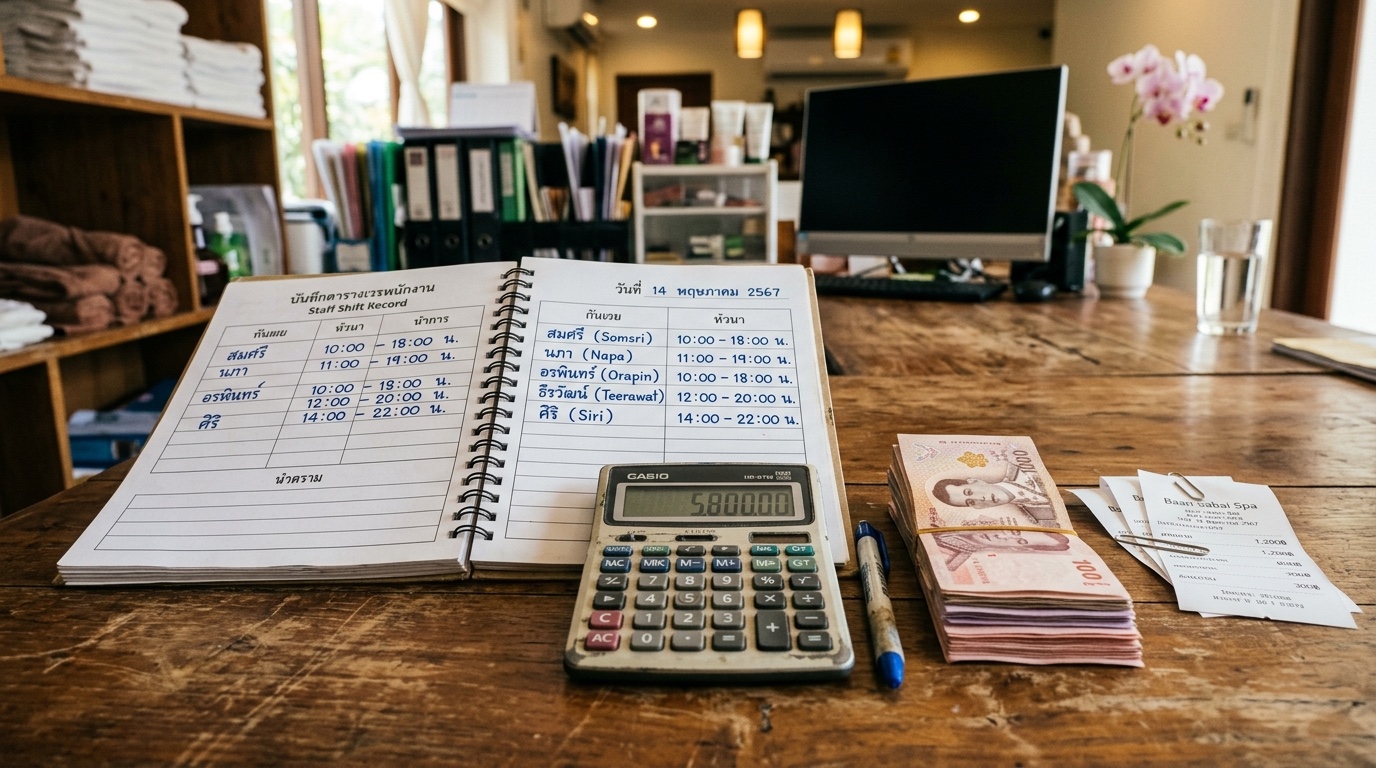
Every payday, someone at the spa opens a spreadsheet, cross-references it against the appointment book, and manually calculates what each therapist earned that month—a base rate here, a percentage there, a different rate for package sales versus walk-in services. Thailand is short an estimated 70,000 massage therapists nationwide—50,000 professional masseurs and 20,000 professional therapists—according to Nation Thailand's December 2024 reporting on the workforce gap, which means the therapists you already have are the ones with the least reason to put up with a payslip that's wrong.
A commission error isn't just a payroll mistake—it's a therapist who now double-checks every payslip instead of trusting the business that employs them.
It sounds like a commission error is a small accounting slip that gets corrected next month and forgotten. It isn't—in a market this short on skilled therapists, a wrong payslip is the first data point a good therapist uses to decide whether to keep looking elsewhere. This piece covers why manual commission math breaks down predictably as a spa grows, what a miscalculation actually costs beyond the correction time, and what accurate commission calculation requires.
The Trust Tax: The Price You Pay Every Time the Math Is Wrong
The math itself usually isn't hard—it's the number of variables that grows faster than a spreadsheet can cleanly track. Different commission rates per service type, promotional pricing that changes what the commissionable amount actually is, package sales that get attributed differently than single treatments, and therapists who split shifts across services all at once. Each of these is manageable alone. Together, in a spreadsheet maintained by hand, they're where errors creep in.
Call the cost of those errors the Trust Tax: the compounding price a spa pays once therapists stop assuming their payslip is correct and start checking it against their own memory of the month, every single payday. It works itself into the practice, even after individual errors get fixed—the Trust Tax is what remains once therapists start expecting the mistake before it happens.
The errors rarely announce themselves. They show up as a slightly-off number on a payslip that a therapist notices before you do, because it's their money.
What this actually costs beyond the recalculation time
The obvious cost is staff time spent recalculating and reconciling. The Trust Tax is the less obvious one—therapists talk to each other, and a spa known for commission mistakes, even honest ones, becomes a spa where good therapists start looking for somewhere their pay is calculated correctly the first time. With Thailand's therapist shortage running in the tens of thousands, that's not an abstract retention risk—it's the difference between a therapist staying through a slow season or taking the next offer that comes in.
Picture a hypothetical spa called Suan Sabai Spa, a growing operation that went from two therapists to six over eighteen months. At two therapists, the owner recalculated commission by hand in twenty minutes each payday. At six, with three service tiers and a new package promotion running, the same process took most of an afternoon—and a rounding mistake on a promotional rate meant one therapist was underpaid for two months before she caught it herself. That same growth point—adding staff and locations faster than a manual system can track—is exactly where stock tracking across branches starts breaking down too.
What accurate commission calculation actually requires
It's not about a fancier spreadsheet template—it's about commission being calculated from the same record as the service that was actually performed, automatically, at the moment it's logged, rather than reconstructed afterward from memory and a booking log. That means the commission rate needs to be tied to the service type and any promotional terms at the time of the appointment, not applied as a flat guess during the monthly calculation. That package-versus-single-treatment split isn't unique to payroll, either—see how membership packages and single-treatment pricing pull in different directions for the same tension showing up on the sales side.
The Trust Tax Playbook
- Commission at the Source — calculate commission from the appointment record itself, the moment a service is logged, not from a separate reconciliation later.
- Rate Tied to Reality — commission rates and promotional terms are attached to the service type and the date it happened, not applied as a flat assumption at month-end.
- Payslip Transparency — every therapist can see exactly which appointments their commission came from, so a question gets answered in a minute, not a full recalculation.
- Onboard the Math Early — when a new service tier or promotion launches, define its commission rule the same day, not retroactively once the first payslip looks wrong.
A car dealership paying sales staff commission on a mix of new-car margin, finance add-ons, and trade-in bonuses hits the identical problem—the moment the variables outgrow a spreadsheet, the Trust Tax starts building with every paycheck, whatever's actually being sold.
Trust: what this all comes down to
If there's one word for what accurate commission calculation actually protects, it's Trust—not the spreadsheet, not the payroll process, just a therapist's confidence that the number on their payslip is right without having to check it themselves.
So here's the question worth sitting with: if you asked your best therapist right now whether they trust their last payslip completely, would the answer be an immediate yes? If it isn't, that's the Trust Tax already being paid, quietly, every month.
FAQ
Why does commission calculation get harder as a spa grows, when the math itself doesn't change?
Because the number of variables—service tiers, promotions, package rates, split shifts—grows faster than a manual spreadsheet can track cleanly, even though each individual calculation stays simple.
Is a commission error really a retention risk, or just an accounting issue?
Both, but the retention risk is the bigger one. Therapists talk to each other, and repeated mistakes—even honest ones—push skilled staff toward employers who calculate pay correctly the first time.
Does automating commission calculation remove the need for a manager to review payroll?
No. It removes the manual recalculation and the errors that come with it—a manager still reviews the output, just from an accurate starting point instead of a hand-built one.
What's the first sign a spa's commission process is breaking down?
A therapist asking a question about their payslip that takes more than a few minutes to answer, because nobody can point to the specific appointment the number came from.
What this looks like with NAWA Spa
NAWA Spa calculates staff commission automatically based on the services actually performed, tied to each appointment as it happens rather than reconstructed at payroll time. Combined with service and package setup that reflects your actual pricing and promotions, commission payouts come from the same record your therapists and front desk already trust—not a separate spreadsheet someone rebuilds every month.
If commission calculation is eating a chunk of every payday and you want to see how it could work without the spreadsheet, talk to us about your current process.
Sources: Nation Thailand, More massage therapists to be trained to counter shortage, December 2024