

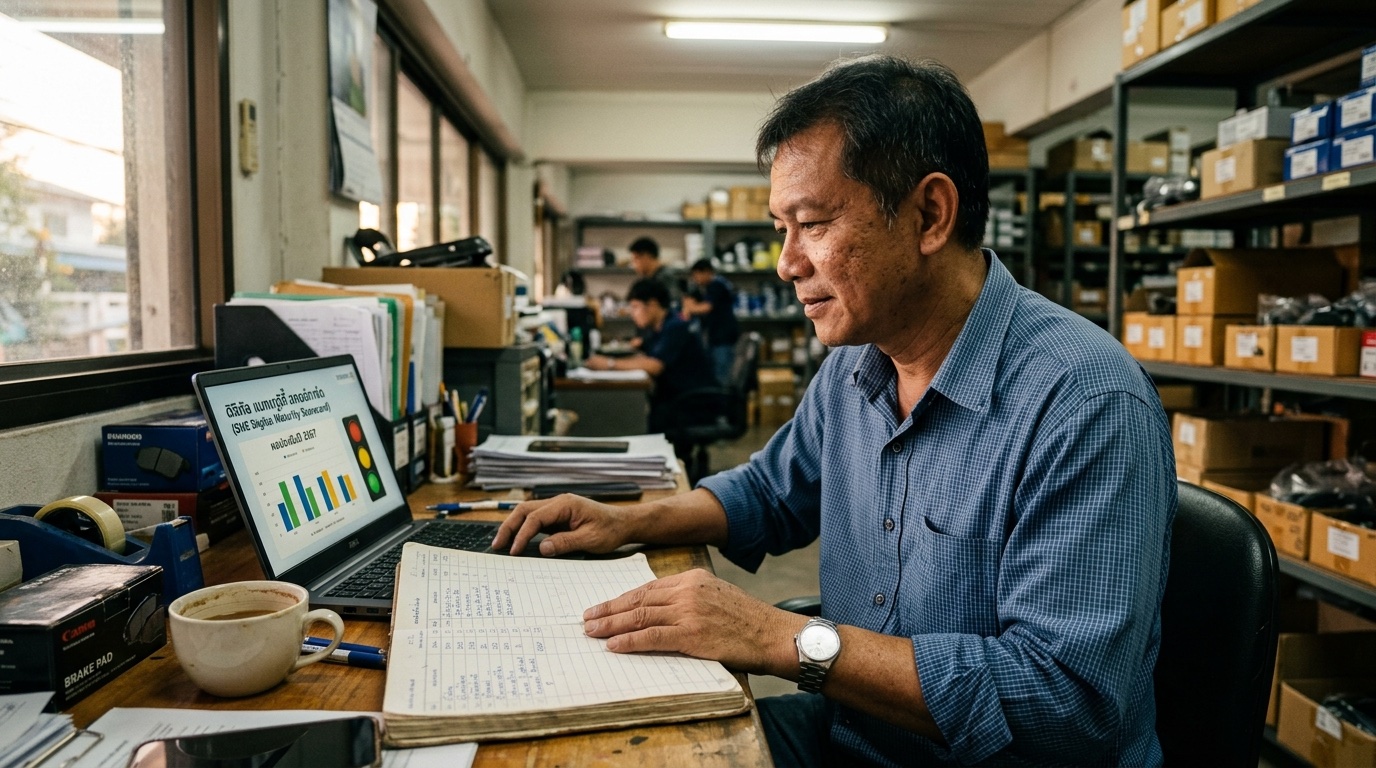
A noodle-shop owner in Nonthaburi posts the day's specials on Facebook, takes payment through a POS app, and replies to customers on LINE within minutes. By almost any casual definition, that's a digitally fluent small business. Ask the same owner how many kilos of pork are actually left in the walk-in fridge right now, or which supplier delivered late three times last quarter, and the answer is a shrug, or a walk to the kitchen to go check.
That gap is exactly what Thailand's own Digital Maturity Index measured in 2025: the country's roughly 3.3 million SMEs scored an average of 2.45 out of 4.00, up 3.81% from 2.36 the year before — enough movement to sound encouraging, and enough to be misread. ETDA classifies most of these businesses as "Digital Followers," a category with a specific, less flattering definition: they've adopted some technology, but haven't yet turned it into a real competitive advantage.
It sounds like a story about Thai SMEs being behind on digital adoption in general. It's actually a story about exactly where that adoption stopped — and the index itself shows which layer of the business it never reached. This piece walks through what the 2.45 score actually measures, which specific functions are pulling it down, and why that particular layer is the one ERP was built to close.
Thai SMEs didn't skip digital adoption — they adopted the customer-facing half of the business and left the operational half exactly where it was.
The Digital Follower Score: What 2.45 Out of 4.00 Actually Measures
ETDA's 2025 Digital Maturity Index scores Thailand's SME population on a 4-point scale and classifies businesses into readiness tiers based on the result. Most fall into "Digital Follower" — technology is in use, but not yet connected into a real operating advantage. The year-over-year change, from 2.36 to 2.45, is real progress, but it's a 3.81% gain against a population of roughly 3.3 million businesses, which is closer to a slow drift than a transformation.
Government policy is already responding to that pace. The SMEs Growth 2026 initiative aims to push SMEs past "Digital Follower" status using AI and digital tools, targeting 500 million baht in economic value creation through a mix of knowledge-sharing, technology access, financing arranged through partner banks, and expert consultation. That's a meaningful program, but it's aimed at the average score — and the average hides a split that matters more than the headline number.
The Storefront-Backroom Split: Sharp Up Front, Stuck Out Back
Read past the headline score and the index describes two very different businesses living inside one average. The stronger half is customer-facing: most Thai SMEs sit at what the survey calls a fundamental level here, but a functioning one — using social media to communicate with customers, running sales through a POS system. That's real digital adoption, and it shouldn't be dismissed just because it's basic.
The weaker half is what happens after the sale. Data analytics is explicitly the lowest-scoring dimension in the index — the finding is that many operators already recognize data matters, but genuinely don't know how to collect it in a usable form. Inventory management optimization sits in the same weak band, alongside a more specific failure: even when data is collected, most SMEs still can't turn it into a decision that changes how the business runs. Call it the Storefront-Backroom Split — a business can look fully digital from the customer's side of the counter and still be running on memory, spreadsheets, and phone calls the moment you step behind it.
Picture a hypothetical company called Areeya Home & Living, a fictional four-branch home-goods retailer across Chiang Mai and Chiang Rai. Areeya's Instagram and LINE OA are genuinely good — quick replies, sharp product photos, real engagement. Checkout runs on a modern POS at every branch. On paper, that's a digitally capable small business. But each branch keeps its own stock count in its own spreadsheet, updated whenever someone remembers, and head office only learns a bestselling lamp sold out in Chiang Rai when a customer complains that the website said it was in stock. Areeya would score well on the customer-facing half of any digital maturity survey. The unmeasured half — the one actually throttling its growth — is exactly the gap the index is describing.
Why the Operations Layer Doesn't Close Itself
The Storefront-Backroom Split doesn't close through more social media training, and it doesn't close by itself as a business gets more comfortable with the tools it already has — those tools were never built to talk to each other in the first place. Connecting live stock, purchasing, and sales data across branches is a system-design problem, not a familiarity problem, which is exactly why the seven operational signs that a Thai SME has outgrown Excel and LINE tend to show up well after a business is already comfortable using digital tools day to day. And when inventory, purchasing, sales, and accounting stop agreeing with each other, no amount of front-of-house polish fixes it — the fix has to happen in the layer underneath.
It also matters because the money is already moving toward this exact gap. Thai SMEs are already telling researchers that digital investment is rising in 2026 — which raises a sharper question worth asking before any of that budget is committed: is it actually aimed at the operations layer the index says is weakest, or is it about to repeat the same customer-facing pattern that produced today's uneven 2.45 score? Where that 2026 digital budget is actually headed is worth reading before deciding.
The Storefront-Backroom Playbook
- Score Yourself Honestly — before assuming "we're digital" settles the question, separately rate your own customer-facing tools and your own operational data. Most SMEs will find the two numbers don't match.
- One Number, One Owner — assign a named owner to your live stock count, your sales total, and your customer record, the same discipline that closes the Coordination Tax between departments that keep separate versions of the truth.
- Data Before Automation — build a reliable operational data layer before layering AI or automation tools on top of it; a fast tool fed unreliable numbers just produces confident-sounding mistakes faster.
- Cross-Industry Check — a boutique hotel group with a sharp Instagram feed and a polished booking site can carry the exact same Storefront-Backroom Split if its housekeeping, maintenance, and procurement still run on paper behind the front desk; the survey wouldn't catch it, but the P&L will.
Depth: What This Actually Comes Down To
If there's one word for what Thailand's 2025 Digital Maturity Index is really measuring, it's Depth — not whether a business uses digital tools, but how far past the counter those tools actually reach.
Here's a fair question to sit with: add up every digital tool your business already uses — the social page, the POS, the LINE OA, maybe a sales report. How many of them actually talk to each other without a person retyping a number in between? That count is closer to your real digital maturity score than any survey result will ever be.
FAQ
What is Thailand's Digital Maturity Index and who publishes it?
It's ETDA's (Electronic Transactions Development Agency) annual scoring of Thai SME digital readiness on a 4-point scale, most recently reporting a 2025 score of 2.45, up from 2.36 the year before.
What does "Digital Follower" actually mean?
It's the tier most Thai SMEs fall into: businesses that have adopted some digital tools but haven't yet connected them into a real operating or competitive advantage.
Which specific business functions score weakest in the index?
Data analytics is the single lowest-scoring dimension, with inventory management optimization and turning collected data into business decisions close behind — the operational layer, not the customer-facing one.
Does a low data-analytics score mean an SME needs to buy new software immediately?
Not immediately. It means the honest next step is measuring exactly where your own data breaks down — which spreadsheet, which handoff, which branch — before shortlisting any tool to fix it.
How does this connect to the government's SMEs Growth 2026 program?
The program is aimed at moving SMEs past "Digital Follower" status using AI and digital tools, targeting 500 million baht in economic value creation — but it funds and advises around the gap the index describes; it doesn't close it automatically.
What this looks like with NAWA ERP
NAWA ERP connects inventory, purchasing, sales, and reporting into one system shaped around how your business actually runs, so a branch's real stock count and head office's view of it are the same number — not two spreadsheets that happen to agree on a good day. Modules go live in stages, starting with whichever process is currently costing the most in duplicated entry or delayed reporting.
If your business already looks digitally capable from the customer's side of the counter and you're not sure the same is true behind it, talk to us about where your own Storefront-Backroom Split actually sits.