

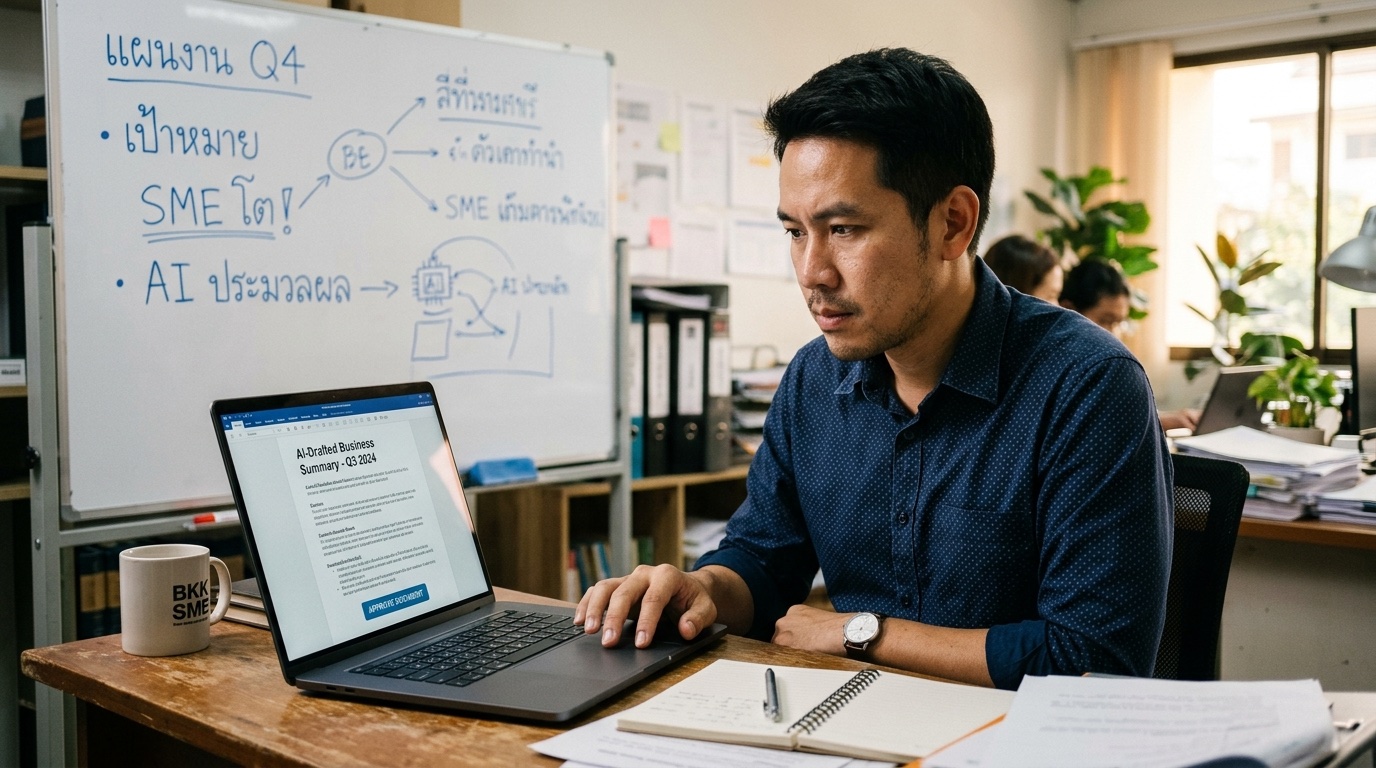
Every week, someone in a typical Thai SME back office does the same unglamorous task by hand: pulling last week's sales numbers into a summary for the owner, drafting a reorder note to a supplier, answering the same HR policy question a third time this month. It's the kind of work "agentic AI" — software that plans and carries out multi-step tasks with less hand-holding than a chatbot — is supposed to be quietly taking over in 2026.
Two real, dated developments back that story up. In June 2026, AIS Business and Microsoft launched "AI Ready for SMEs," bundling Microsoft 365 Copilot with ready-made AI agent templates for Thailand's 3.13 million SMEs — 99.6% of all businesses in the country. And in a January 2026 survey of 265 Thai SME owners and senior decision-makers, UOB found 71% already deploying AI in their operations, with 89% planning to increase their AI budgets in 2026.
It sounds like Thai SME back offices are already being run by autonomous AI agents. It's actually something narrower and more useful to understand precisely: a small number of named, purpose-built templates, riding on top of a much broader wave of AI adoption that's already producing real, measurable results for the businesses using it — which is a genuinely different thing from a general-purpose autonomous employee. This piece separates what's actually shipping from what's still marketing language, and what the adoption numbers really support.
Agentic AI in Thai SME back offices in 2026 is real, but it's currently a small number of named, scoped templates riding on top of broader AI adoption — not yet the autonomous back office the term implies.
The Template-First Rollout: Packaged Agents Before Full Automation
Here's what AIS Business and Microsoft's "AI Ready for SMEs" program actually ships, not what the headline implies. The service is available from mid-June through September 2026, packaging Microsoft 365 and Copilot together with 24/7 support through AIS's own service desk. The first 1,000 customers who subscribe to the Copilot package get a free Copilot workshop, and subscribers with ten or more licenses get complimentary on-site training. The stated goal is training more than 700 SME entrepreneurs on AI capabilities by the end of 2026, across seven regions of the country.
The AI agent piece of the program is deliberately narrow to start: a "Business Assistant" AI solution that gives business owners insights and recommendations, with Human Resources and Finance templates named as coming next, plus specialized agents planned for specific verticals like smart manufacturing. That's the real shape of "agentic AI" reaching Thai SMEs right now — a small, growing list of named, scoped templates built around specific recurring tasks, not a general autonomous system you point at your whole back office and walk away from.
What the Adoption Data Actually Shows
UOB's survey of 265 Thai SME owners and senior decision-makers, conducted online in January 2026, found that AI adoption in Thailand's SME sector is already well ahead of stated intentions to explore it: 71% of businesses surveyed were already deploying AI in their operations, above the regional average, and 89% said they planned to increase their AI budgets in 2026.
Among the businesses already using AI, up to 58% of surveyed adopters reported immediate savings from AI-driven process automation, and up to 44% reported meaningful productivity gains from AI integration. Those are real, self-reported results from businesses that had already adopted AI — not a guarantee that any given SME will see the same numbers by turning on a tool. It's evidence that the technology is producing genuine value for a meaningful share of early adopters, which is different from evidence that it will automatically do the same for every business that tries it.
Picture This: What a Scoped Agent Actually Looks Like Day to Day
Picture a hypothetical company called Khunying Bakery Group, a fictional multi-branch bakery chain in Bangkok. It pilots a Business Assistant AI template to pull together a weekly sales-and-inventory summary and draft a reorder note to its flour and dairy suppliers for a manager to review each Monday morning. That's real time saved on a specific, bounded task the manager used to do by hand every week. What the template doesn't do is decide the actual reorder quantity unsupervised, write off spoiled stock on its own, or approve a price change with a supplier — a person still makes every one of those calls, using the draft as a starting point rather than a finished decision.
That's what working agentic AI looks like in a Thai SME back office today: a named assistant that drafts and recommends inside one clearly bounded task, with a human holding every real decision. It is not, yet, a general employee you can hand an open-ended instruction and trust to handle whatever comes up.
What's Still Hype, and What to Watch For
Be skeptical of any pitch that implies AI can run a back office end to end without a named, scoped task and a human checkpoint — the concrete programs and data behind this piece don't support that claim yet, even though the underlying adoption trend is real. The templates that exist today are narrow by design: a business assistant, with HR and Finance versions still described as "coming," not already shipping widely. Broader autonomous judgment across approvals, exceptions, and purchasing decisions — the kind of decisions an ERP is built to route and control — isn't demonstrated at Thai SME scale in the data available right now.
The other thing worth watching is the prerequisite underneath all of it: an agent summarizing or drafting from unreliable data just produces confident-sounding mistakes faster than a person would. Thailand's own digital maturity data shows the operational layer — inventory, data analytics, turning information into decisions — is exactly where most Thai SMEs are currently weakest, which is the layer any AI agent depends on being accurate before it can be trusted with real recommendations.
The Scoped Agent Playbook
- Start With a Named Task, Not "AI for Everything" — pick one bounded, recurring back-office task (a weekly summary, a reorder draft, an HR policy answer) before evaluating any agent template against your whole operation.
- Keep a Human on Every Approval — treat an agent's draft or recommendation as exactly that: a draft, reviewed by a person before it becomes a real business action, the same discipline NAWA already applies to AI-drafted review replies.
- Fix the Data Before Adding the Agent — connecting inventory, purchasing, sales, and accounting data properly has to happen before an agent is asked to summarize or act on any of it; an agent is only as reliable as the numbers underneath it.
- Cross-Industry Check — a boutique law firm piloting an AI assistant to draft first-pass client intake summaries faces the identical scoped-task discipline: genuinely useful the moment it stays inside one named, reviewable task, risky the moment someone stretches it into unsupervised judgment.
Scoped: What This Actually Comes Down To
If there's one word for what agentic AI actually looks like in a Thai SME back office in 2026, it's Scoped — not an autonomous employee, but a named, bounded task with a human still holding the final decision.
Here's a fair question to sit with: if you handed your own back office's messiest recurring task to an AI template tomorrow, could you name, precisely, the one decision a human still has to make before anything goes out the door? If you can't name it yet, that's the gap worth closing before you adopt the technology, not after.
FAQ
What does "agentic AI" actually mean for a Thai SME back office, in practical terms?
Right now, it means a small number of named, purpose-built AI templates — like a business-assistant tool that drafts summaries and recommendations — rather than a general system capable of running an entire back office unsupervised.
What does the AIS-Microsoft "AI Ready for SMEs" program actually include?
Microsoft 365 and Copilot bundled together, 24/7 support via AIS's service desk, free workshops for early Copilot subscribers, on-site training for larger license purchases, and a Business Assistant AI template with Human Resources and Finance templates planned to follow.
How many Thai SMEs are already using AI, according to the latest survey?
UOB's January 2026 survey of 265 Thai SME owners and senior decision-makers found 71% already deploying AI in their operations, with 89% planning to increase AI budgets in 2026.
Do the reported cost and productivity gains apply to every business that adopts AI?
No. Up to 58% of surveyed adopters reported cost savings and up to 44% reported productivity gains — real, self-reported results from businesses already using AI, not a guaranteed outcome for every SME that turns on a tool.
What's the biggest thing separating real agentic AI from the hype right now?
Scope. Working examples today handle one named, bounded task with a human reviewing the output; hype framing implies open-ended autonomy across a whole back office, which isn't demonstrated at Thai SME scale yet.
What needs to be true before an SME can use agentic AI reliably?
Reliable underlying operational data. An agent summarizing or recommending from inaccurate stock, sales, or customer data will produce confident-sounding mistakes faster than a person would — the data layer has to be trustworthy first.
What this looks like with NAWA ERP
NAWA ERP doesn't sell itself as an AI agent — its job is building the connected, trustworthy operational data (inventory, purchasing, sales, and reporting all agreeing with each other) that makes any AI assistant or agent layered on top actually reliable rather than confidently wrong. Get the data foundation right first, and whichever scoped AI template you adopt next has something solid to work from.
If you're evaluating an AI agent template for your back office and want an honest read on whether your underlying data is actually ready for it, talk to us about your operational data foundation.