

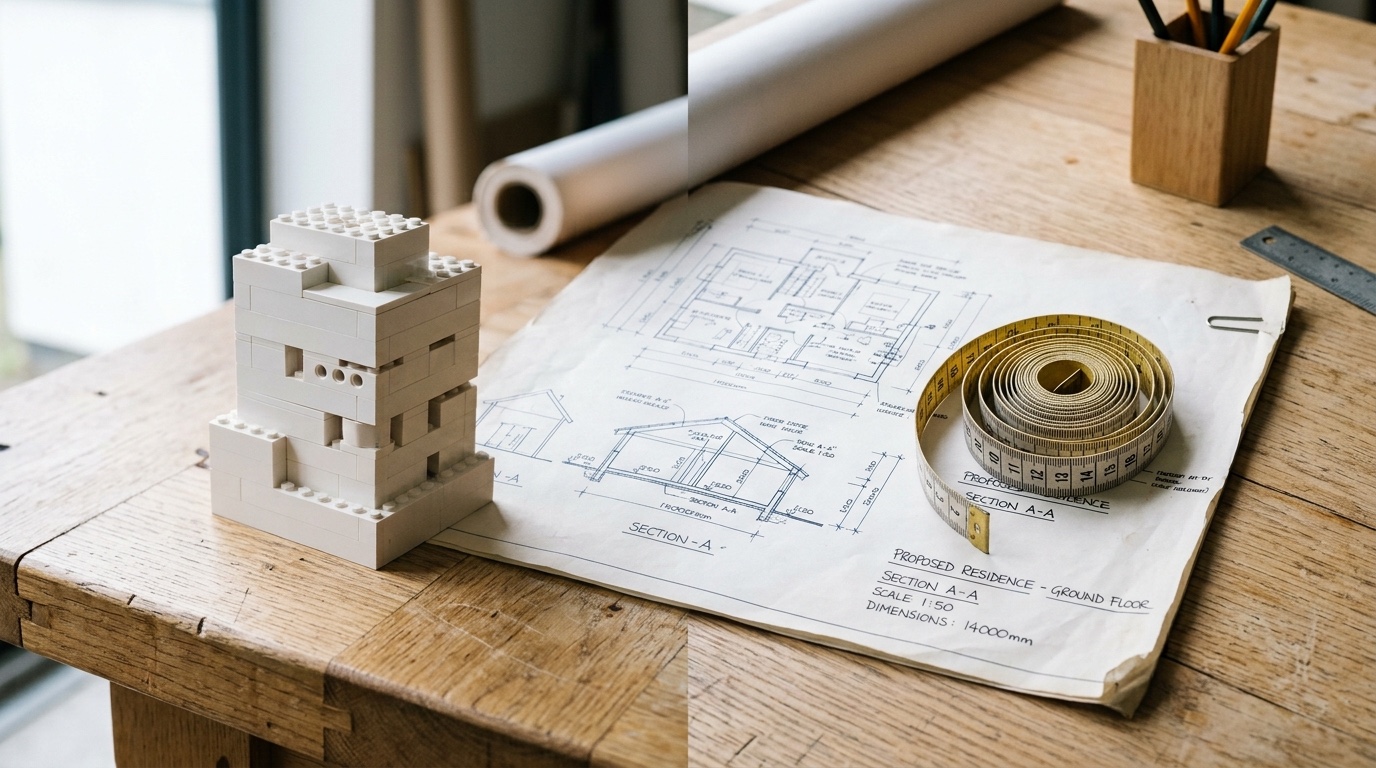
Two proposals sit on the table. One is ready-made ERP: a fixed price, a familiar module list, a go-live date that sounds achievable. The other is custom-built: it fits how the business actually works, at a price nobody can pin down until requirements are finished, on a timeline that depends on people who haven't been hired yet. Most Thai SME owners assume the ready-made option is the "safe" one simply because the number on the page is smaller.
Panorama Consulting Group's 2026 ERP Report, based on 170 organizations surveyed between January 2025 and January 2026, found that more than a quarter of ERP projects went over budget and almost a quarter ran over schedule — and the single most common cause of a budget overrun wasn't ambition. It was discovering, mid-project, that the chosen system needed additional technology nobody scoped at the start.
It sounds like a build-versus-buy decision. It's actually a risk-allocation decision: ready-made ERP trades flexibility for a smaller, more predictable set of unknowns; custom ERP trades predictability for a system that might actually match how the business runs. Neither option removes risk — each just moves it somewhere different, and the real question is which kind of risk your business can absorb.
Buy the standard parts. Customize the work that truly makes the business different.
This piece compares the real strengths and risks of both paths, looks honestly at what a global implementation survey does and doesn't tell a Thai SME, and walks through a fit-gap process for deciding which parts of your operation are worth customizing at all.
Ready-made ERP: Real Strengths, Real Risks
Ready-made ERP offers proven modules, vendor-maintained updates, wider documentation, and faster access to the common inventory, purchasing, and accounting patterns most businesses actually need. It generally suits businesses willing to adopt a standard way of working rather than insisting the software bend to every existing habit.
The risks are configuration complexity, features you're paying for but never use, recurring licence fees, dependence on one vendor's roadmap, and awkward workarounds for the handful of things that make your business genuinely different from the vendor's average customer.
Custom ERP: Real Strengths, Real Risks
Custom ERP can fit specialized approvals, pricing logic, production sequencing, or service delivery that a generic package simply wasn't built around — including requirements like Thailand's e-Tax Invoice and PromptBiz document flows, which a standard package may not support cleanly out of the box. It also gives the business real control over its own roadmap instead of waiting for a vendor's release calendar.
The risks are discovery cost, requirements that keep shifting mid-build, a heavier testing burden, thinner documentation unless you insist on it, security review that falls entirely on you, dependence on the one or two people who actually understand the system, and permanent maintenance responsibility that doesn't end at go-live.
The Ownership Bill: What a 170-Company Study Actually Shows
Every ERP project — custom or ready-made — eventually presents what's worth calling the Ownership Bill: the maintenance, support, and "who actually understands this system" cost that arrives after go-live, whether or not anyone priced it into the original proposal. Ready-made ERP tends to hide this bill inside recurring subscription fees and version-upgrade cycles. Custom ERP tends to hide it inside a key person's job description.
Panorama's 2026 report is worth reading carefully rather than quoting selectively. It surveyed 170 organizations — 56.5% multinational, with a median annual revenue of $200.5 million and a median project timeline of nine months — so this is not Thai-SME-scale data, and it should not be cited as if it were. What it does show, honestly, is the shape of the risk on projects large enough to be studied in detail: 50.6% finished on budget, but 30% finished over budget (22.9% slightly, 7.1% significantly), and the leading cause was the unexpected need for additional technology (54.9%), followed by initial scope expanding mid-project (51.0%). On timeline, 58.8% finished on time, but 22.3% ran over schedule, most often because of organizational issues like delayed sign-offs and change resistance (57.9%), not technical failure.
The lesson for a much smaller Thai SME isn't the exact percentages — it's the pattern underneath them: overruns rarely come from the software itself. They come from scope that wasn't actually fixed at the start, and from organizational friction nobody budgeted time for. A ready-made package with a fixed price doesn't remove that risk; it just makes the first estimate look more certain than it usually turns out to be.
Picture a hypothetical company called Thai Fresh Foods, a fictional mid-sized food processor with a production sequence that doesn't match any standard manufacturing template — batches depend on ingredient freshness windows that shift daily. A ready-made ERP quote looked attractive until the demo couldn't actually represent Thai Fresh Foods' real production sequence, only a simplified version of it. A custom quote could model the real sequence, but carried the same overrun risk Panorama's data describes: undiscovered scope, in this case the freshness-window logic nobody had fully documented before requirements were written down. Neither proposal was inherently the safe one — the safer path was the one where Thai Fresh Foods tested the highest-risk part of its actual process before committing to either.
Use a Fit-Gap Decision, Not a Feature Checklist
Map your critical processes and classify each requirement: standard and acceptable as-is, configurable without custom code, requiring integration with another system, a genuine competitive differentiator, or simply a historical habit with no current value. Customize only when the value clearly outweighs the lifetime complexity it adds. A hybrid architecture — standard finance and inventory modules paired with a tailored operational layer for the part of the business that's actually different — often deserves serious consideration before either pure option.
Compare Total Cost and Protect Your Exit
Include licences, implementation, data migration, integrations, customization, training, internal staff time, support, upgrades, hosting, security, testing, and exit cost across at least three to five years, not just the first invoice. The cheapest-looking proposal is often simply the one that hasn't priced the difficult parts yet.
Define data export rights, documentation standards, source-code ownership where relevant, hosting access, service levels, security responsibilities, the update process, and transition support before you sign — not after you decide to leave. Approve discovery, prototype, data migration, pilot, and rollout as separate stage gates, comparing evidence against agreed success criteria at each one before continuing, changing course, or stopping.
The Ownership Bill Playbook
- Highest-Risk Prototype First — before committing to a full roadmap, build a working prototype of the single riskiest workflow, whether that's a custom production sequence or a ready-made system's most-used report.
- Scripted, Not Scenic, Demonstrations — give every vendor the identical set of hard scenarios (partial delivery, price exception, return, month-end reconciliation) instead of letting each one show its own best-case story.
- Named Maintenance Owner — decide, before go-live, exactly who owns the system after the implementation team leaves, and budget their time as a real cost, not a footnote.
- Cross-Industry Check — a logistics company choosing between a ready-made fleet-management module and a custom dispatch system faces the identical Ownership Bill question: which risk — rigid process or ongoing maintenance dependency — the business can actually absorb long-term.
Fit: What This Actually Comes Down To
If there's one word for choosing between custom and ready-made ERP, it's Fit — not which option is cheaper on day one, but which kind of ongoing ownership cost your business is genuinely equipped to carry for the next five years.
Here's a fair question to sit with: if your highest-risk process broke tomorrow — the one piece of your operation that doesn't match any standard template — do you know, right now, who would actually understand how to fix it? If the honest answer is "no one, yet," that's the gap worth closing before you sign either kind of proposal.
FAQ
Is custom ERP always riskier than ready-made ERP?
Not necessarily — the risk simply shows up differently. Ready-made risk tends to appear as process compromise and subscription dependence; custom risk tends to appear as scope growth and maintenance dependence. Neither is automatically safer.
Does the Panorama data apply directly to a small Thai SME?
Not literally — that study's respondents were mostly larger, often multinational organizations. The specific percentages won't match SME scale, but the underlying pattern (overruns coming from scope and organizational friction, not the software itself) applies regardless of company size.
What's the single best way to reduce overrun risk before committing?
Build or demand a working prototype of your highest-risk process before approving the full roadmap — for either custom or ready-made proposals. Untested assumptions, not the build method itself, are what usually cause the overrun.
Can a hybrid approach really work, or is it just indecision?
It's a legitimate architecture, not a compromise for its own sake — standard modules for the parts of your business that work like everyone else's, paired with a custom layer only for the process that's genuinely different, often balances cost and fit better than either pure option.
If you're weighing a ready-made quote against a custom proposal and want a second opinion grounded in your actual workflows, request an ERP fit-gap workshop from NAWA and we'll help you compare both against your real five-year ownership cost.