

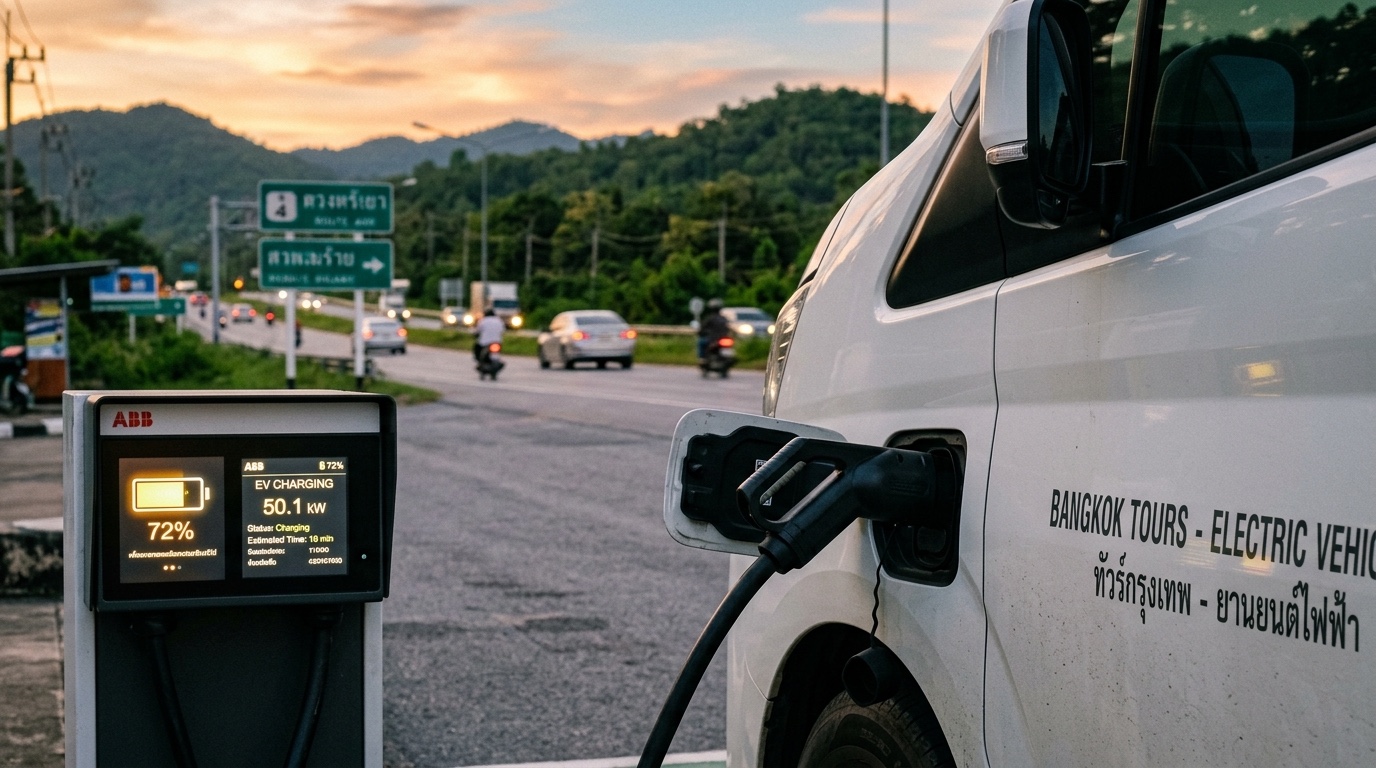
Bangkok is leasing 1,520 electric buses under a seven-year, 465-million-dollar contract running from 2025 to 2032. City officials have stated the EV buses are three times cheaper to operate than the combustion-engine buses they replace, and the Bangkok Mass Transit Authority is targeting retirement of roughly 60% of its diesel fleet—about 2,300 vehicles—by 2029.
A "3x cheaper to operate" figure travels fast through an industry looking for good news on fuel and maintenance costs. It sounds like a number that should apply to any fleet decision—if buses save that much, vans and cars should too. It doesn't automatically transfer that cleanly. BMTA's economics come from thousands of vehicles running fixed, high-frequency urban routes with dedicated depot charging—a very different operating profile from eight vans doing scattered airport transfers or a tour fleet covering intercity routes with no charging infrastructure along the way. This piece walks through which parts of the 3x figure actually hold at smaller scale, and which parts depend on conditions most transfer and tour fleets don't have.
A fleet-wide cost advantage measured across thousands of buses on fixed urban routes doesn't automatically shrink down to eight vans doing airport runs—the economics change with scale, route, and charging access.
What the 3x Figure Actually Measures
BMTA's operating-cost comparison reflects fuel-versus-electricity cost per kilometer and reduced maintenance on a fleet that runs fixed routes, returns to the same depot every night, and charges on a predictable schedule with infrastructure the city has already built out. Those three conditions—fixed routes, guaranteed depot access, predictable charging windows—are doing a lot of the work in that 3x number, more than the vehicles themselves.
A transfer or tour fleet without any one of those three conditions is comparing itself to a different economic model than the one that produced the headline figure, even while running the same underlying technology.
Where the Math Holds: Fixed-Route Transfer Operations
The 3x economics travel best to transfer operations that most resemble BMTA's own profile—predictable routes (airport to a fixed set of hotel zones, for instance), a home depot the fleet returns to overnight, and enough volume to justify installing dedicated charging. An airport-transfer operator running the same handful of routes daily, with vehicles parked at one location between shifts, is close enough to the bus fleet's operating pattern that a meaningful share of the fuel and maintenance savings should carry over.
Picture a hypothetical shuttle company called Fah Thai Shuttle running a fixed loop between Suvarnabhumi and a cluster of hotels in the same district. Its route length, return-to-depot pattern, and charging predictability are close enough to a city bus route that the underlying economics BMTA cites are a reasonable starting point for its own EV feasibility math—not a guarantee, but a legitimate comparison.
Where the Math Breaks Down: Range, Charging Infrastructure, and Route Variability
A tour fleet covering multi-day, intercity routes—Bangkok to Chiang Mai, or scattered pickups across a province with no dedicated depot—faces two problems BMTA's fleet doesn't: range limits that may not cover a full day's route without a midday charge, and no guarantee that charging infrastructure exists wherever the route happens to end that night. An electric van that can't complete its route on a single charge, or that needs to charge at a location without dedicated infrastructure, loses a meaningful share of the cost advantage to downtime, route replanning, or the cost of installing charging where none currently exists.
This is the same gap that shows up in Bangkok's own light rail and tunnel infrastructure investments concentrating in specific zones like Phuket rather than arriving evenly across the country—EV economics, like transit infrastructure, tends to work best where the infrastructure investment has actually landed, and worse everywhere else, at least for now. Fleets rebalancing away from lost group-tour volume, like the coaches sitting idle after the Chinese arrivals forecast cut, are often exactly the vehicles worth running this feasibility check against first, since a smaller reshaped fleet is easier to convert than a large one already committed to fixed contracts.
The Electric Fleet Feasibility Playbook
- Route Pattern Match — compare your actual route profile (fixed vs. variable, depot-return vs. multi-stop) against BMTA's fixed-route, depot-return model before assuming the 3x figure applies.
- Charging Infrastructure Audit — confirm dedicated charging exists (or is feasible to install) everywhere your fleet actually needs to charge, not just at a home base.
- Range-to-Route Check — verify vehicle range comfortably covers your longest single-day route without a mid-route charge, with margin for traffic and detours.
- Partial Electrification First — consider converting the routes that match the fixed, depot-return pattern first, rather than electrifying the whole fleet on one timeline.
A last-mile delivery company facing the same range-and-charging math for its own van fleet would run the identical playbook—match route pattern to infrastructure reality before committing capital to a technology whose economics were proven somewhere else.
Route Match: what this all comes down to
If there's one word for whether Bangkok's electric bus economics apply to your fleet, it's Route Match—not the vehicle technology itself, just how closely your actual routes and charging access resemble the conditions that produced the 3x figure in the first place.
So here's the question worth sitting with: if you mapped your fleet's routes against fixed-route, depot-return, dedicated-charging criteria, how many of your vehicles would actually qualify—and is that number worth acting on before the rest of the fleet does?
FAQ
Is the 3x operating-cost figure specific to Bangkok's buses, or a general EV claim?
It's specific to BMTA's electric bus fleet under its current lease contract—officials cite it in that context, and it reflects that fleet's particular route and charging conditions rather than a universal figure for all electric vehicles.
Do smaller transfer fleets get the same government support BMTA received?
Not automatically—BMTA's contract is a large-scale municipal lease agreement. Smaller operators considering EVs would need to research separately whether relevant incentives or financing programs apply to their situation.
What's the biggest risk in electrifying a tour fleet too early?
Committing capital to vehicles whose range or charging needs don't match your actual routes, leading to downtime or forced route changes that erase the operating-cost savings the technology is supposed to deliver.
Should an operator wait for more charging infrastructure before considering EVs?
It depends on route profile—operators with fixed, depot-return routes may already have enough infrastructure predictability to evaluate EVs now, while those with variable, multi-stop or intercity routes may reasonably wait for infrastructure to catch up.
What this looks like with NAWA Travel
NAWA Travel's route and vehicle-utilization reports show exactly which routes in your fleet run the fixed, predictable pattern that makes an EV feasibility case worth building, and which ones don't—so a fleet electrification decision starts from your own operating data instead of a headline percentage borrowed from a different kind of fleet.
If you're evaluating whether any part of your fleet is a realistic candidate for electrification, talk to us about your current route and vehicle data.
Sources: Royal Thai Embassy Washington DC, "Bangkok's Public Bus Fleet Is Going Electric"