

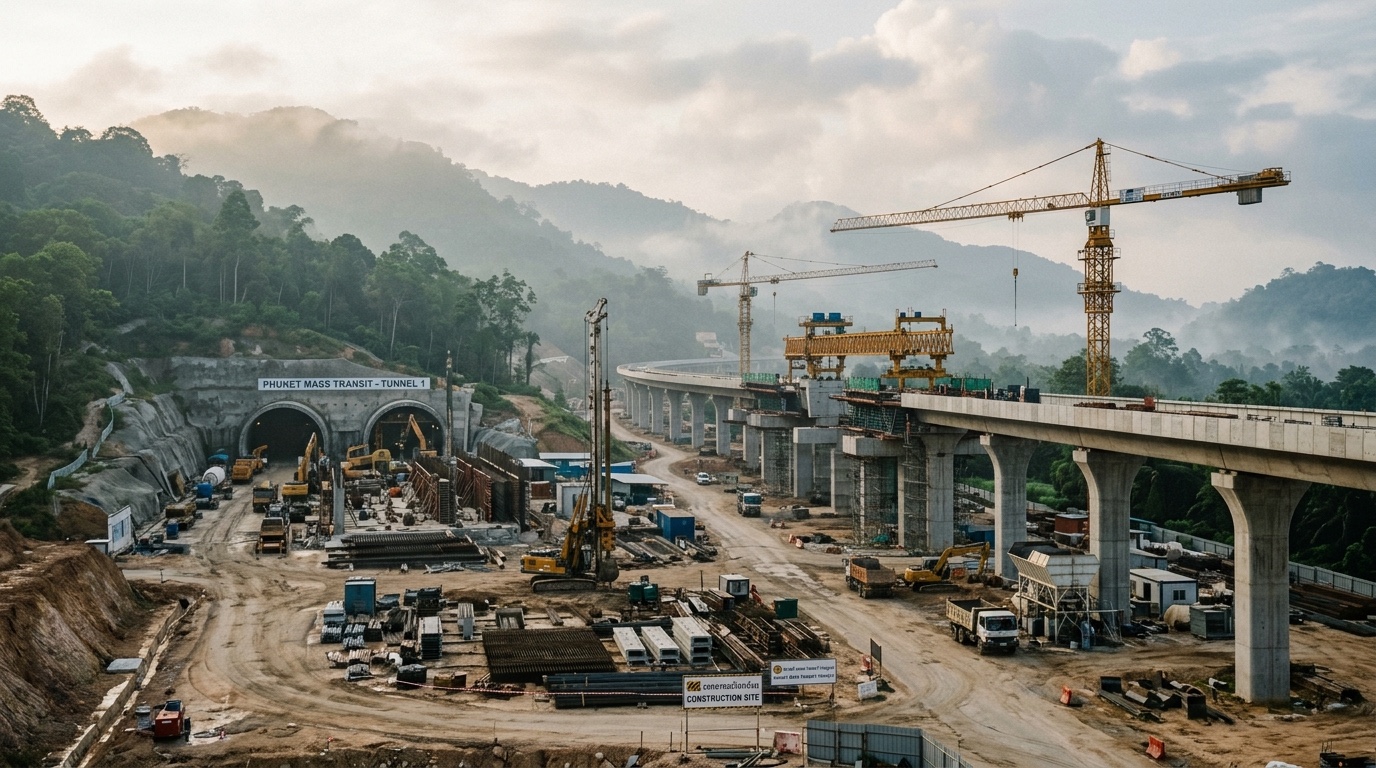
Phuket's government infrastructure package includes the Kathu-Patong Tunnel, a new Muang Mai-Koh Kaew-Kathu expressway, an AI-controlled traffic management system, and a light rail network—funded against 2024 figures of nearly 13 million visitors, up 14.14%, generating over 481 billion baht in tourism revenue. Nearly all of the coverage of this package is written for travelers, framed around whether the island's notorious congestion will finally ease.
It sounds like a story with one clean outcome—these projects finish, traffic gets better, done. For a transfer or tour operator, it isn't that simple. Multi-year infrastructure projects don't improve conditions on a single completion date; they reshape congestion patterns unevenly for years before, during, and after construction, and each phase changes route timing and capacity planning differently. This piece looks at what each project actually means operationally, and how to plan routes through years of change rather than waiting for a finish line.
Most Phuket infrastructure coverage is written for travelers wondering if congestion will improve. For a transfer operator, the same projects are a multi-year route-planning problem that starts well before any of them open.
Construction-Phase Disruption Happens Before Any Benefit Does
Every one of these projects—the tunnel, the expressway, the light rail—makes the roads worse before it makes them better. Construction on the Kathu-Patong corridor means lane closures, detours, and unpredictable delays on one of the island's most heavily used transfer routes, for a period of years, before the tunnel itself opens and delivers any congestion relief at all.
An operator planning routes as if today's traffic patterns are the baseline to schedule against is planning against conditions that are actively changing under construction, not a stable state. The realistic planning window isn't "before vs. after the tunnel opens"—it's a multi-year stretch of shifting disruption that needs its own scheduling buffer, separate from whatever buffer the eventual finished infrastructure will allow.
The AI Traffic System Changes Signal Timing Before the Roads Physically Change
An AI-controlled traffic management system is a faster-moving change than a tunnel or rail line—it can alter signal timing and traffic flow patterns on existing roads well before any construction on the bigger projects finishes. That means route timing that's been reliable for years can shift with comparatively little public notice, simply because the system managing signal timing itself has changed.
Picture a hypothetical airport shuttle company called Andaman Transfers running a fixed schedule between Phuket International and Patong. A signal-timing change from an AI traffic system that shaves four minutes off one intersection and adds six to another doesn't show up in any construction announcement—but it changes whether Andaman's drivers are hitting their pickup windows reliably. The operators who notice signal-timing drift early, and adjust schedules in response, avoid the slow creep of "on-time" becoming "usually on time" without ever pinpointing why.
Light Rail Changes the Long-Term Route Map, Not Just Traffic Volume
A light rail network doesn't just reduce road congestion—it changes where demand concentrates. Stations become new pickup and dropoff hubs, hotel guests near a station may shift some trips to rail instead of a transfer vehicle entirely, and route economics for transfers that run parallel to the rail line change once a lower-cost alternative exists on the same corridor. This is a genuinely different kind of adjustment than a tunnel that simply moves the same transfer demand through less congested roads—see how Suvarnabhumi's own phased capacity growth reshapes demand on a fixed schedule for the airport-side version of planning against an infrastructure timeline rather than a single completion date.
An operator whose route network today assumes today's lack of rail alternatives should start modeling which routes are most exposed to a light rail corridor now, well before the line opens, rather than reacting once ridership numbers make the shift obvious. Any fleet being reshaped by these route shifts is also worth evaluating against whether electric vehicles pencil out for the routes that survive the transition, since a genuinely new route map is the natural moment to reconsider vehicle technology too.
The Multi-Year Infrastructure Playbook
- Construction-Phase Buffers — build separate scheduling buffers for the disruption period, distinct from whatever buffer the finished infrastructure will eventually allow.
- Signal-Timing Monitoring — track actual trip times against schedule regularly, since AI traffic system changes can shift timing without a public announcement tied to it.
- Rail-Corridor Exposure Mapping — identify which routes run parallel to the planned light rail line and model how much demand might shift once it opens.
- Phase-Aware Route Review — revisit route timing and capacity assumptions at each project's construction milestone, not just at final completion.
A hotel group scheduling airport shuttles on a fixed timetable faces the identical exposure—the same signal-timing drift and construction disruption that affects a transfer company's routes affects a hotel's own shuttle fleet running the same roads.
Phased: what this all comes down to
If there's one word for how to plan transfer routes through Phuket's infrastructure buildout, it's Phased—not "before and after," just a series of shifting conditions that each need their own read, well ahead of any single completion date.
So here's the question worth sitting with: for your most-used Phuket routes, do you know which infrastructure phase they're currently running through—construction disruption, a signal-timing change, or still-stable conditions—or has route timing just quietly drifted without anyone tracing it back to a cause?
FAQ
When will Phuket's congestion actually improve from these projects?
There's no single date—each project (tunnel, expressway, AI traffic system, light rail) has its own timeline, and construction-phase disruption typically precedes any benefit by a period of years.
Does the AI traffic management system require new infrastructure to take effect?
No—it can adjust signal timing on existing roads, meaning its effects can show up before any physical construction on the tunnel or light rail is complete.
Will the light rail reduce demand for transfer services?
It's likely to shift some demand for specific routes running parallel to the rail line, particularly short trips near stations, though transfer demand for airport connections and multi-stop tours will likely remain largely unaffected.
How should a transfer operator prepare for years of construction disruption?
Build a separate, generous scheduling buffer specifically for the construction period on affected routes, and review it periodically as the project progresses rather than setting it once and leaving it unchanged.
What this looks like with NAWA Travel
NAWA Travel keeps route and trip data in one system, so if pickups on a Phuket route start running later than usual—whether from construction disruption or a quieter signal-timing change—it shows up in your own trip history before it becomes a pattern of late pickups no one traced back to its actual cause.
If you're managing routes through Phuket's infrastructure buildout and want to catch timing drift early, talk to us about your current route tracking.
Sources: Nation Thailand, "Plans to make Phuket a premium tourist destination outlined"