

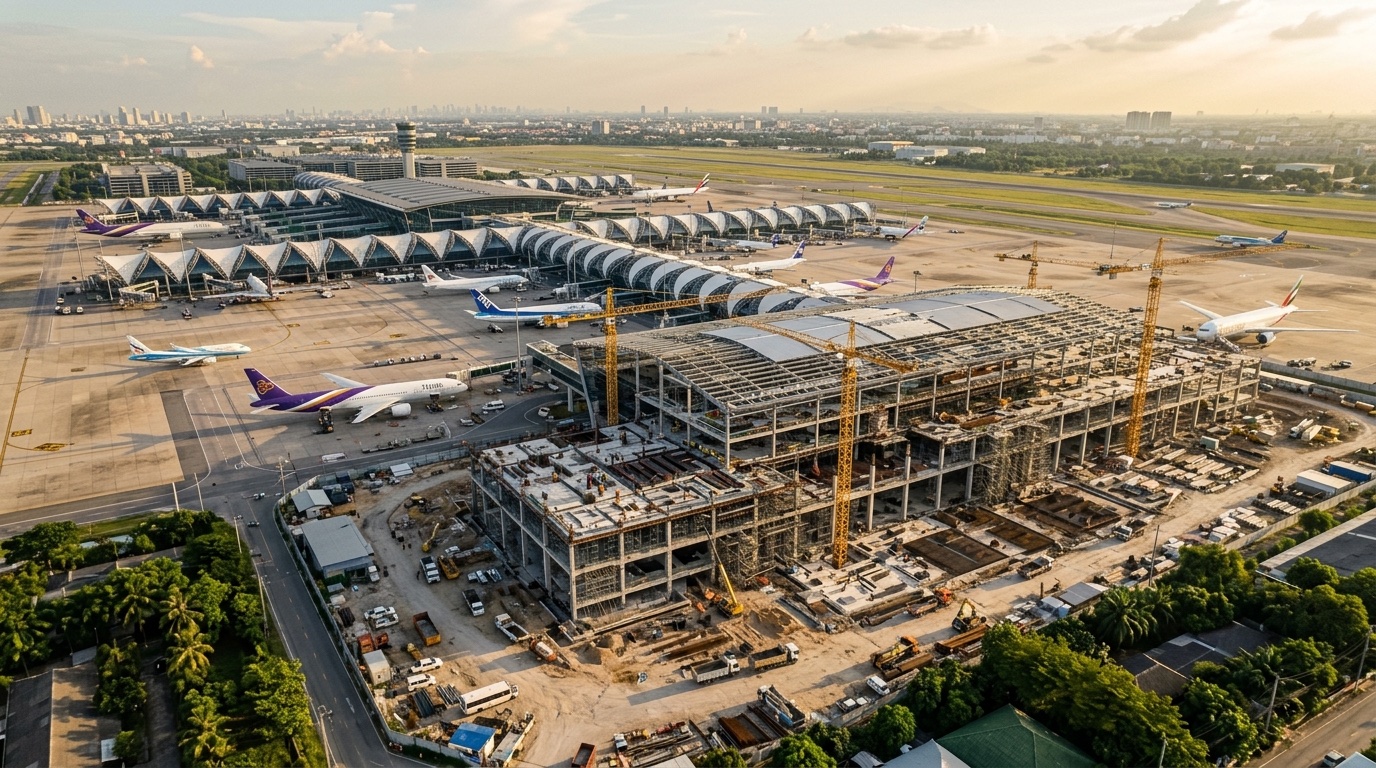
Airports of Thailand has committed 364.98 billion baht to a six-airport expansion roadmap targeting 180 million annual passengers by 2034. Suvarnabhumi's East Expansion runs 2026 through 2030 and lifts capacity to 70 million; its South Terminal, running 2027 through 2035, pushes capacity further to 120 million. Don Mueang, Phuket, Chiang Mai, Chiang Rai, and Hat Yai each get phased expansions on their own separate timelines.
Most tourism coverage of this plan treats it as a single headline number—180 million passengers, one big future. It sounds like a story about eventual national capacity, arriving somewhere out past the planning horizon most transfer and tour businesses actually operate on. It isn't. Read closely, the roadmap is a phased, airport-by-airport demand curve, and each phase lands on a specific fleet, route network, and staffing plan years before the 180-million figure is anywhere close to true. This piece breaks down what each airport's timeline actually implies for transfer and tour demand, and how to plan capacity against a roadmap instead of a headline.
Airport capacity doesn't arrive all at once, in one city. It arrives in phases, at specific airports, on a published schedule—and that schedule is a demand forecast most ground-transport operators aren't reading.
Reading the Roadmap as a Demand Curve, Not a Headline Number
AOT's plan isn't one expansion—it's six, staggered, at different airports, each with its own capacity jump and completion date. Suvarnabhumi's East Expansion (2026–2030, to 70 million) reaches its target years before its South Terminal (2027–2035, to 120 million) finishes. Don Mueang, Phuket, Chiang Mai, Chiang Rai, and Hat Yai each carry separate phased timelines behind that headline 180-million, six-airport, 2034 figure.
Treating "180 million by 2034" as the planning number means missing that Suvarnabhumi's East Expansion alone lifts capacity to 70 million on a fixed 2026–2030 schedule—demand that arrives years before the 2034 headline, not on it. A transfer or tour operator planning fleet and staffing against the single headline number is planning against the wrong curve entirely.
Why Suvarnabhumi's Timeline Matters More Than Its Final Number
Suvarnabhumi's East Expansion and South Terminal projects actually run concurrently for three years—construction on the South Terminal starts in 2027, three years before the East Expansion itself finishes in 2030. But the capacity gains still land in two distinct steps: 70 million by 2030, then 120 million by 2035. That first step—reaching 70 million—is the one that lands years before 2034, not at the finish line. An operator waiting for capacity signals that only show up once the full 180-million target nears will already be behind demand that arrived years earlier.
Picture a hypothetical hotel group called Siam Vista Hotels planning a new property near Don Mueang. Its feasibility study modeled guest volume off the airport's 2034 endpoint capacity, not the phased timeline leading up to it—and ended up under-planning staff and shuttle capacity for the years in between, when actual passenger growth was already outpacing the group's assumptions. The lesson applies just as directly to a transfer fleet: planning against an endpoint instead of a phase schedule means being consistently behind the curve that's actually unfolding.
Regional Airports Move on Independent Clocks
Phuket, Chiang Mai, Chiang Rai, and Hat Yai each have their own expansion timelines within the same 364.98-billion-baht plan, and each implies a different regional transfer and tour demand curve—not a scaled-down version of Suvarnabhumi's. An operator running fleets across more than one of these airports needs a separate capacity read for each one, because a Phuket-specific infrastructure shift (see the Kathu-Patong tunnel and light rail's route-planning implications) can move faster or slower than what's happening at Chiang Mai or Hat Yai in the same year.
Assuming regional airports track Suvarnabhumi's pace, even directionally, risks either overbuilding fleet capacity somewhere demand hasn't caught up yet, or underbuilding it somewhere growth is arriving faster than the national headline suggests. Growing passenger volume also raises the compliance bar operators are measured against—see what Thailand's ride-hailing law means for verification and documentation standards for the regulatory side of scaling alongside this roadmap.
The Airport Capacity Playbook
- Airport-by-Airport Timelines — pull the phase dates for every airport your fleet actually serves, not the single national completion year.
- Front-Loaded Growth Awareness — check whether an airport's near-term phase adds more capacity per year than its later phases; plan fleet growth to match, not a flat annual assumption.
- Regional Independence — treat each regional airport's roadmap as its own demand curve, not a smaller copy of Suvarnabhumi's.
- Phase-Ahead Fleet Planning — size vehicle and driver capacity to the demand implied by the *next* phase completion date, not the plan's final target year.
A car-rental company sizing its Phuket and Chiang Mai fleets separately, rather than allocating vehicles by a single national growth assumption, is applying the identical logic—regional demand curves move independently, and treating them as one hides where the actual capacity gap will show up first.
Timelines: what this all comes down to
If there's one word for what actually matters in AOT's 180-million-passenger roadmap, it's Timelines—not the size of the final number, just when each airport's specific capacity jump actually lands.
So here's the question worth sitting with: for the specific airport your fleet serves most, do you know the exact year its next capacity phase completes—or are you still planning against "eventually, by 2034"?
FAQ
Is the 180-million-passenger target for one airport or the whole country?
The whole country—it's the combined target across all six airports in AOT's expansion plan (Suvarnabhumi, Don Mueang, Phuket, Chiang Mai, Chiang Rai, and Hat Yai) by 2034, not a single-airport figure.
When does Suvarnabhumi's capacity actually increase?
In phases: the East Expansion runs 2026–2030 and lifts capacity to 70 million, while the South Terminal, running 2027–2035, pushes capacity further to 120 million.
Do regional airports grow at the same pace as Suvarnabhumi?
No—each of the five regional airports in the plan has its own phased timeline, and demand growth at each should be planned separately rather than assumed to track Bangkok's pace.
How should a transfer operator use this roadmap for fleet planning?
Match fleet and staffing growth to the completion date of the *next* capacity phase at the specific airport served, not the plan's overall 2034 target year.
What this looks like with NAWA Travel
NAWA Travel gives transfer and tour operators one operational view across vehicles, drivers, and routes, so scaling fleet capacity ahead of a specific airport's next phase is a planning decision backed by real booking and utilization data—not a guess made off a national headline number.
If you're mapping fleet growth against Thailand's airport expansion timeline and want to see where your current capacity already stands, talk to us about your operation.
Sources: Nation Thailand, "AOT plans major airport expansion to serve 180m passengers"