

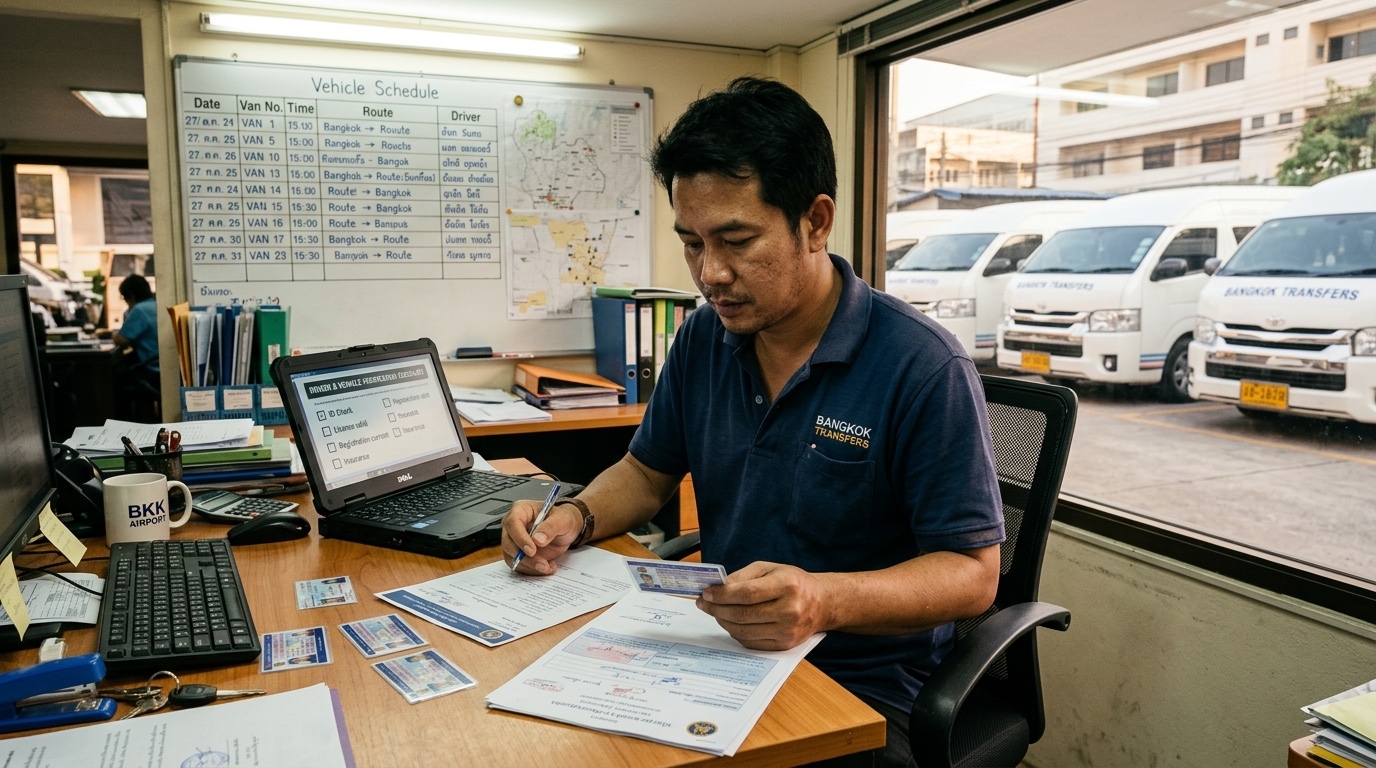
Since October 2025, every ride-hailing platform operating in Thailand has had to verify its drivers and vehicles, run KYC through ThaID, display GPS and fare data to passengers in real time, and file operational reports with the Department of Land Transport. Most coverage of the law framed it as a passenger-safety story—background checks, visible fares, less risk of an unlicensed driver behind the wheel. Almost none of it asked what happens to the transfer and tour operators who were never part of the app-based ride-hailing conversation in the first place.
It sounds like a law for a different kind of business—consumer apps, not B2B airport transfers and pre-booked tours. In practice, the law has reset what "verified" and "accountable" mean for ground transport across Thailand, and every operator now gets compared against that new bar, whether they run an app or not. This piece walks through what the Digital Platform Services law actually requires, why it applies more directly to transfer and tour operators than it first appears, and what changes if you decide to treat its standard as your own baseline instead of waiting to be asked.
The law was written for app-based ride-hailing, but the compliance bar it sets is now the one every ground-transport operator is measured against, whether they run an app or not.
The Verification Baseline: The New Rule That Resets What "Verified" Means
The Electronic Transactions Development Agency's Digital Platform Services law requires ride-hailing platforms to verify both drivers and vehicles before they can accept a booking, run identity checks through ThaID, and keep that verification current rather than as a one-time signup step. None of this is new in spirit—reputable transfer companies have always vetted their drivers—but the law turns an internal best practice into an external, checkable standard.
That matters because a hotel concierge, a corporate travel buyer, or a tour operator evaluating a ground-transport partner now has a public reference point for what "properly verified" looks like. A transfer company that can point to the same rigor the law requires of ride-hailing platforms—current licenses, vehicle registration, an identity check tied to the actual driver on the job—is answering a question buyers increasingly know to ask, even if the law itself never mentions transfer companies by name.
Why GPS and Fare Transparency Reach Further Than the Ride-Hailing Apps
The law requires ride-hailing platforms to show passengers GPS tracking and fare information in real time. For a metered ride-hailing trip, that's mostly about trust during the ride. For a pre-booked airport transfer or a multi-day tour, the same expectation shows up differently: a corporate travel manager or a tour operator's B2B partner increasingly expects to see where a vehicle is and what a trip actually costs, not just receive a confirmation email and hope the driver shows up.
Picture a hypothetical logistics company called Chaiyo Freight that runs a fleet of delivery vans across Bangkok. It never has to comply with the ride-hailing law directly, but its corporate clients have started asking for live GPS tracking on high-value shipments anyway, because that visibility is now what "good" looks like across ground transport generally, not just for the vehicles the law actually regulates. Transfer and tour operators are in the same position: the law didn't name them, but it moved the goalposts for everyone adjacent to it.
The DLT Reporting Requirement Sets a Documentation Standard, Not Just a Filing Obligation
Platforms under the law must submit operational reports to the Department of Land Transport—driver and vehicle records, trip data, the kind of operational history that used to live only in an internal spreadsheet, if it was tracked consistently at all. A transfer or tour operator isn't required to file these reports. But the law's existence means DLT-style documentation—who drove which vehicle, on which trip, when—is now a recognizable standard a business can be asked to produce, whether by a corporate client's compliance team, an insurer after an incident, or a B2B partner doing due diligence before signing a contract.
An operator that can produce that trail on request, cleanly and quickly, is demonstrating exactly the kind of operational maturity the law was designed to force onto ride-hailing platforms—just arrived at voluntarily instead of by regulation. For the airport-transfer specific version of this same visibility problem, see why more booking channels increase collision risk without a shared schedule. The same documentation discipline matters more, not less, as airport capacity grows—see what AOT's phased passenger-capacity roadmap means for transfer demand for how that growth curve actually unfolds.
The Ride-Hailing Standard Playbook
- Verification as Default — treat driver and vehicle verification as an ongoing check, not a one-time onboarding step, matching the standard the law sets for ride-hailing platforms.
- Visible Trip Data — be ready to show a client GPS location and fare information on request, even if your business model doesn't require it by law.
- DLT-Style Records — keep driver, vehicle, and trip records in a format you could hand to a compliance team or insurer without a scramble.
- KYC Discipline — apply the same identity-verification rigor to your own driver roster that ThaID enforces on ride-hailing platforms, so "verified" means the same thing across your fleet.
A private security firm providing corporate transport for executives faces the identical trust gap: clients want to know the driver behind the wheel was actually vetted, not just that a name appears on a roster somewhere.
Verification: what this all comes down to
If there's one word for what the ride-hailing law actually changed for ground transport in Thailand, it's Verification—not a new set of forms to file, just a public, checkable standard for what "properly vetted" now means.
So here's the question worth sitting with: if a corporate client or B2B partner asked you today to prove your drivers and vehicles are current and verified, how long would it take you to produce that—and would it hold up to the same scrutiny the law now applies to ride-hailing platforms?
FAQ
Does the Digital Platform Services law legally apply to transfer and tour companies?
Not directly—it regulates ride-hailing platforms specifically. But it has reset buyer expectations for verification, transparency, and documentation across ground transport generally, so operators outside its scope are still measured against the standard it set.
What does ThaID-based KYC actually require?
The law requires ride-hailing platforms to verify driver identity through Thailand's national digital ID system, ThaID, rather than relying on documents submitted once at signup. It's a stronger, more current form of identity verification than a photocopied license on file.
Do transfer companies need GPS tracking to comply with this law?
No—compliance obligations fall on the platforms the law defines. But client expectations for live trip visibility have risen alongside the law regardless, particularly among corporate and B2B travel buyers.
What should an operator do if they're not sure whether the law applies to them?
Treat the law's requirements as a floor for buyer expectations rather than trying to determine legal applicability alone—a consultation with a Thai regulatory or transport-law specialist is the right next step if the business model is ambiguous.
What this looks like with NAWA Travel
NAWA Travel keeps driver and vehicle records, trip history, and job assignments in one system, so producing a clean operational record for a corporate client, insurer, or compliance review doesn't mean digging through spreadsheets and chat logs. Every confirmed trip becomes a job order with the driver, vehicle, and passenger details attached from the start.
If you're fielding more questions from B2B partners about verification and trip visibility and want your records ready before you're asked, talk to us about your current driver and vehicle tracking setup.
Sources: Nation Thailand, "New ride-hailing law to be enforced from October 2025"