

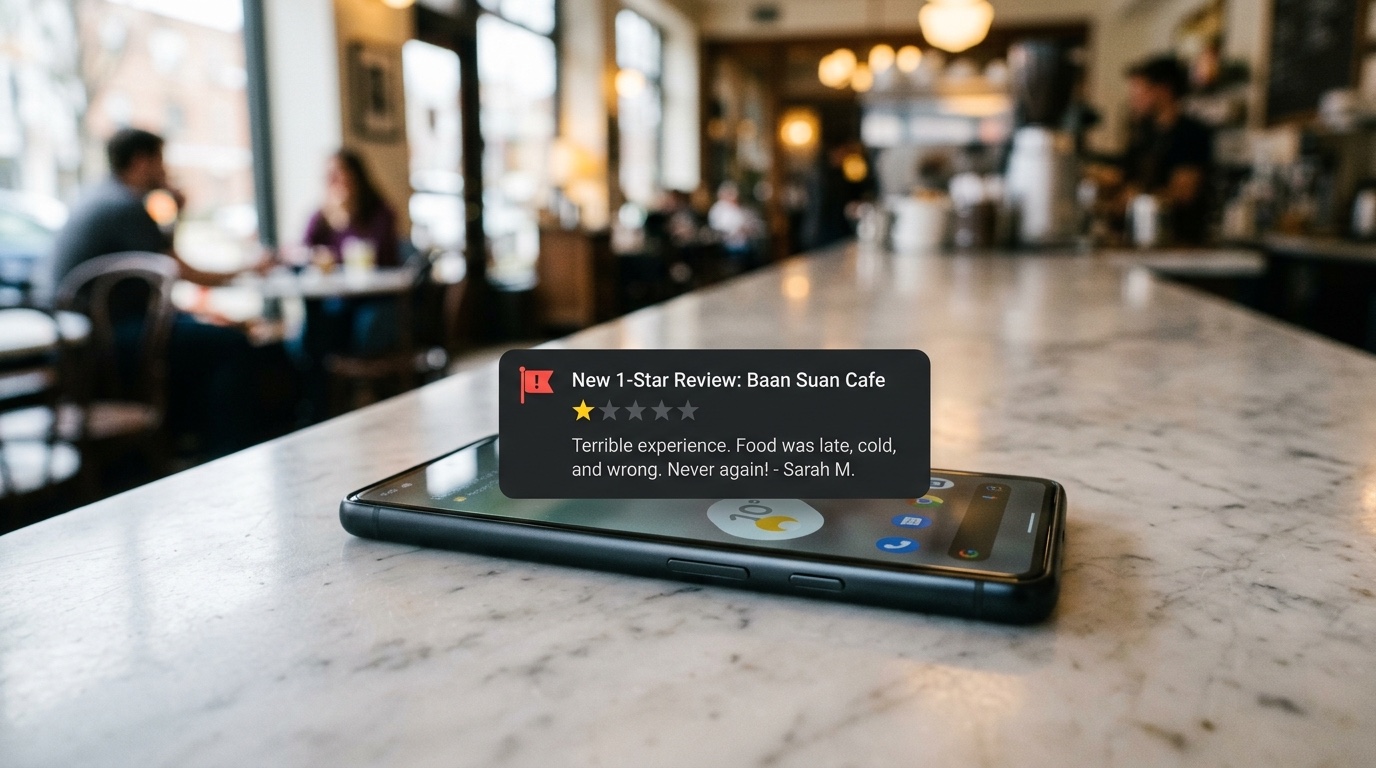
A one-star review appears overnight, posted by an account with no photo and no other reviews, describing a stay that doesn't match any booking on record. The emotional impulse is to answer immediately—defensive, specific, maybe a little angry. The operational answer is to preserve evidence first.
Google's own 2025 Maps transparency reporting shows its systems blocked or removed more than 292 million policy-violating reviews and removed over 13 million fake Business Profiles that year alone. Google: New ways we're protecting businesses on Maps That number sounds like reassurance—Google is already fighting this at scale, so an individual business barely needs to worry. It isn't quite that simple. Google's systems catch an enormous volume of fake content, but they can't verify the specific context of your booking records, your staff schedule, or a competitor with a grudge, which means the first move on any suspicious review still has to come from you.
This piece covers how to classify what you're actually dealing with, how to build an evidence file that holds up, and when to publish a public response versus stay quiet while a report is pending.
Respond to the evidence, follow the platform process, and protect the brand from your own frustration. A calm, documented case travels further than an angry, fast one.
Classify before acting
Separate four situations:
- A genuine negative experience you simply dislike.
- A factual disagreement about a real visit.
- Content that may violate platform policy.
- A serious threat, privacy, safety, or legal issue requiring specialist advice.
Google states plainly that businesses should not report reviews simply because they disagree with them—removal exists for policy violations, not for unflattering opinions. Google: Report inappropriate reviews
Evidence Lock: securing your case before emotion takes the wheel
Call this Evidence Lock: the discipline of capturing and freezing everything relevant to a disputed review before you respond publicly, report it, or discuss it with anyone outside a small case team. Evidence Lock happens before any decision about what to say—not after.
Skipping straight to a reply is how businesses accidentally weaken their own case. A defensive public comment posted in the heat of the moment can contradict the calm, factual report filed an hour later, and a platform reviewing both will notice the inconsistency before it notices your side of the story.
Record screenshot, URL, reviewer profile, date, exact wording, booking search results, staff notes, and any relevant communication. Avoid gathering unrelated personal information about the reviewer—the goal is documentation, not a dossier.
Report through the platform
Choose the closest accurate policy reason and submit your evidence. Track the case number, the decision, and any appeal deadline. Google's own guidance notes that evaluation typically takes several days, and provides a one-time appeal process for reviews still flagged as policy-compliant after a first report. Google: Report inappropriate reviews
Report once with good evidence rather than repeatedly changing categories hoping one sticks. Procedures and stakes differ by channel—understanding how Google and OTA reviews carry different weight in a guest's booking decision helps you judge how urgently to act on a fake review depending on where it appeared.
Publish a measured response when useful
If the content remains visible while a report is pending, answer for future readers, not for the reviewer:
We take this concern seriously but cannot match the details provided to a customer record. We have reported the content for platform review. If this relates to a genuine visit, please contact [channel] with the date and booking name so our team can investigate privately.
Do not reveal booking history, identity guesses, or security footage details. Do not threaten legal action in a public reply—that decision belongs with counsel, not a duty manager under pressure.
Picture a hypothetical wellness business called Chom View Spa—a fictional single-location spa used here only as an illustration, not a real client. Chom View noticed six near-identical one-star reviews land within the same afternoon, each mentioning a "rude therapist" without naming one, from accounts with no other review history. Rather than replying to each one individually and escalating a public back-and-forth, the manager locked the evidence, reported all six under the same case reference, and posted one calm, identical holding response to each—exactly the kind of coordinated pattern Google's own content policy exists to catch. Google Maps content policy
Learn even when the review is unfair
A disputed review can still reveal unclear policies or weak documentation. Ask whether staff could have proven what was promised, whether the listing set the right expectation, and whether escalation notes were complete. Not every disputed review is purely malicious—some sit in a gray zone worth learning from regardless of the outcome.
For serious defamation, threats, or personal-data exposure, pause public engagement and seek qualified Thai legal advice. Platform guidance is not a substitute for law—and in some jurisdictions, regulators are treating fake reviews as a genuine enforcement priority rather than a platform-only problem. The US Federal Trade Commission's final rule banning fake and incentivized reviews, effective October 2024, is one signal of that broader direction, even though it applies to US commerce rather than Thailand directly.
Set an internal escalation ladder
Frontline staff should know when to stop and hand off. Create named routes for ordinary disputes, threats, privacy exposure, safety allegations, discrimination claims, and coordinated review attacks. Preserve evidence and restrict access to people who actually need it.
Use one case owner. Multiple employees filing separate reports, messaging the reviewer, and drafting replies independently can create contradictions and weaken the evidence you've already locked down.
What not to say publicly
Avoid publishing "we know who you are," describing CCTV footage, quoting private messages, accusing competitors without proof, or promising a removal you can't guarantee. Even when the business feels certain, the public reply should stay within verifiable facts and platform rules.
Recover trust while the decision is pending
Update the business profile, answer other genuine feedback, and check whether the disputed claim exposes a policy that's genuinely unclear. This is easier when disputed reviews sit inside a broader reputation management workflow that spans every guest-feedback channel, not treated as a one-off crisis handled by whoever's on shift. Future readers judge the full pattern, not only one post.
The Evidence Lock Playbook
- Freeze First—capture every relevant detail before writing a single public word, so nothing you say later can undercut the case you're building.
- One Case Owner—a single named person manages the report, the public reply, and the internal record, so the story stays consistent.
- Calm, Identical Holding Line—when several suspicious reviews land at once, use the same measured response on each rather than improvising a new one under pressure every time.
- Cross-Industry Vigilance—a hypothetical Bangkok restaurant hit by a cluster of one-star reviews the same week a negative news story breaks about a competitor faces the identical Evidence Lock decision: freeze the pattern, report once with evidence, and resist the urge to name names in public.
Lock: what it all comes down to
If there's one word for how to survive a fake or abusive review without damaging your own brand in the process, it's Lock—securing the facts before anyone, including you, says something in public that can't be taken back.
So here's a question worth sitting with: if a suspicious review landed on your profile right now, do you already know who takes the first screenshot, who owns the case, and who has the authority to approve the public reply—or would that get figured out live, under pressure, for the first time? If it's the second one, that's the gap worth closing before you actually need it.
FAQ
How common are fake reviews really?
Common enough that Google alone blocked or removed over 292 million policy-violating reviews in 2025—a scale that suggests no business should assume a suspicious review is a one-off fluke without checking the pattern first.
Should we report every negative review we disagree with?
No. Google is explicit that disagreement alone isn't grounds for removal—reporting is for policy violations like fake engagement, conflicts of interest, or coordinated attacks, not for reviews you simply wish were more flattering.
How long does a platform take to review a report?
Google's own guidance says evaluation typically takes several days, with a one-time appeal available if the first decision finds no policy violation.
Can we ask staff or friends to leave positive reviews to balance out a fake one?
No. That violates Google's content policy on incentivized and conflict-of-interest reviews, and it can get genuine reviews removed alongside the fake ones if the pattern looks coordinated.
What's the single biggest mistake businesses make with a suspicious review?
Responding emotionally in public before evidence is locked down—a defensive first reply often creates more reputational damage than the original fake review did.
NAWA Trust keeps every Google Business Profile review—including the ones you've flagged or disputed—in one inbox with status visible, so a suspicious review doesn't quietly get lost while a report is pending or while several staff members are each trying to track it separately. It won't file the report to Google for you, but it keeps your evidence organized and your case owner working from one shared view instead of a screenshot folder. Talk to us about your current workflow and we'll help you find the clearest place to start.