

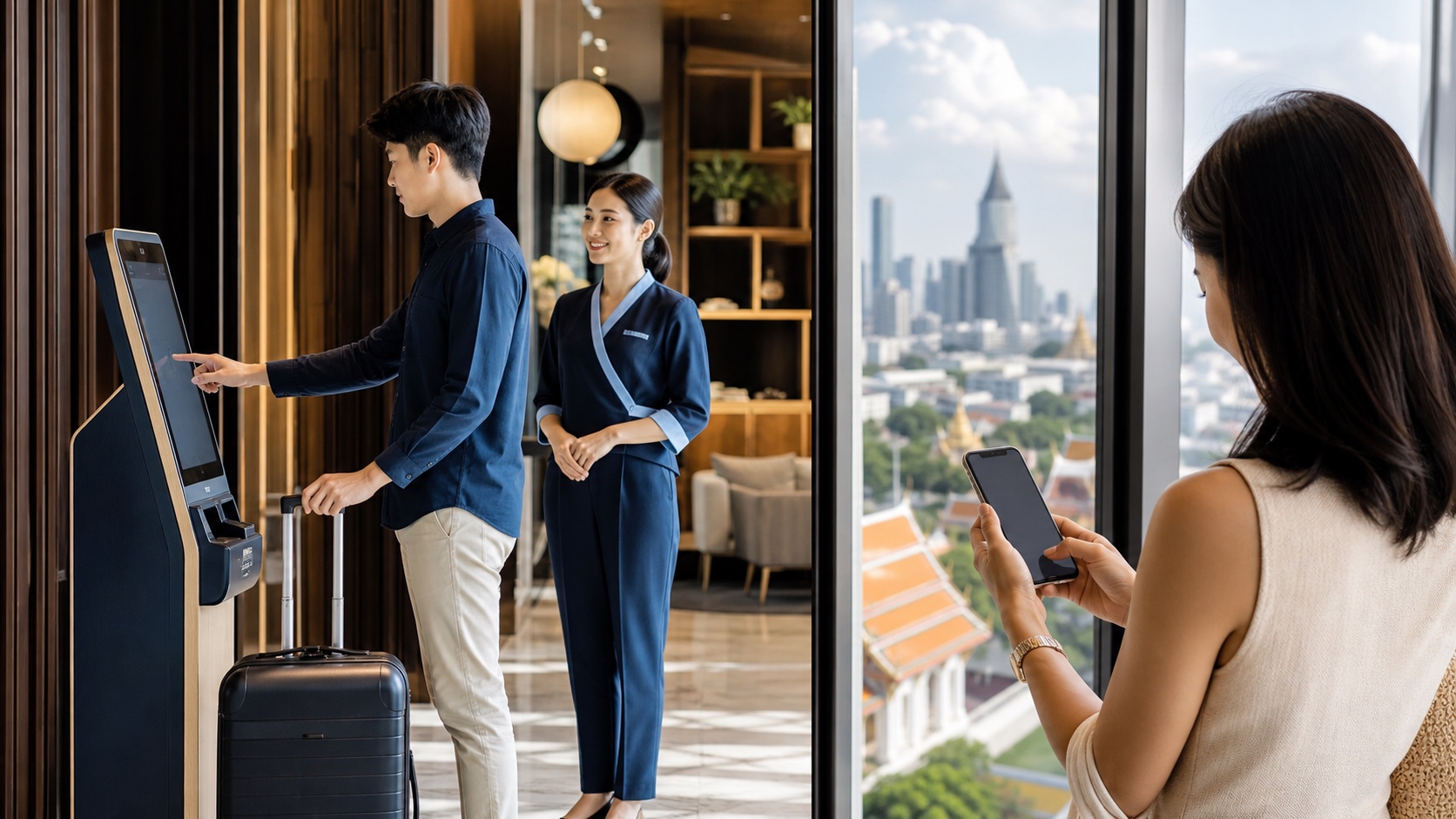
The queue appears at 2:07 p.m. Three rooms are ready, two are not, and the guest at the front is looking for a booking confirmation in an email thread from six months ago. This is usually when a hotel starts dreaming about self-check-in.
A 2025 US survey of 2,000 travelers by hotel platform Mews found that 70% would rather check in with an app or self-service kiosk than the front desk—rising to 82% among Gen Z. That is a strong signal of where guest expectations are heading, even if the survey itself was American, not Thai. But in that same release, Mews reported something more sobering from its own hotel customers: across properties that have actually installed a self-service kiosk, only around 30% of guests use it, even though it cuts check-in time by roughly a third for those who do.
The first decision often sounds simple: install a lobby kiosk or let guests check in on their phones. It sounds like choosing which hardware to buy. It is actually a decision about where to place the same amount of work—on hotel hardware, or on the guest's own device and the pre-arrival journey—and about how big a gap you're willing to accept between guests who could use a channel and guests who actually finish using it.
This guide compares kiosk and mobile check-in across eight practical factors, when a hybrid model wins, and what Thailand's payment and identity landscape adds to the decision.
Choose the channel your guests will complete and your team can support—not the hardware that photographs best.
The difference in one minute
A self-check-in kiosk is hotel-owned hardware in the lobby. Guests find a reservation, confirm details, complete required steps and may receive a key card or access code.
Mobile check-in starts from a secure link or hotel app. Guests complete some or all steps before arrival using their own phone. The hotel then provides a key, PIN or short staff-assisted handoff.
Both can reduce repetitive desk work. Neither fixes a confusing process by itself. If the property management system (PMS), payment status and room readiness disagree, the new screen merely presents the disagreement faster. Getting that agreement right depends on how you connect self-check-in to your PMS, smart locks, payments, and LINE.
The Completion Gap: why "offered" and "used" are different numbers
Every self-check-in rollout eventually has to answer an uncomfortable question: how many guests who *could* use the channel actually *finish* using it? Call the difference the Completion Gap.
The Mews figures above are a useful illustration, not a Thailand benchmark: a strong majority say they'd prefer self-service, yet actual completion at hotels that installed the hardware sits closer to a third. The gap isn't guest laziness—it's usually message timing, trust, device friction, or simply not knowing the option exists. A kiosk that's technically available closes none of that gap if nobody points a tired guest toward it. A mobile link closes none of it if it arrives during the airport transfer instead of the night before.
Whichever channel you choose, plan to measure the Completion Gap directly—offered versus completed—rather than assuming a channel "works" because you installed it.
When a kiosk is the better fit
A kiosk is useful when guests arrive without completing pre-arrival messages, the property operates late or without a fully staffed desk, or hardware must encode and dispense key cards. It can also make self-service visible—guests don't need to search for a link while carrying luggage and negotiating airport Wi-Fi.
Consider a kiosk when arrival volume is concentrated into predictable peaks, walk-ins or same-day bookings are common, key-card production must happen on site, the lobby has accessible space and reliable connectivity, and staff can monitor and recover the device when something fails.
The hidden costs are hardware, installation, card dispensers, payment terminals, maintenance and physical accessibility. A kiosk that needs a receptionist beside it all evening is not self-service—it's a receptionist with a very large accessory.
When mobile check-in is the better fit
Mobile works well when the hotel already communicates effectively before arrival and wants to reduce lobby equipment. Guests can complete forms in their preferred place and time, with more privacy than a public screen.
Consider mobile when most reservations include a reliable contact channel, guests commonly arrive after long journeys and value speed, the property uses PINs or digital keys, lobby space is limited, and there's a clear fallback when a link expires or a guest needs help.
Mobile completion depends on message timing, trust and usability—the Completion Gap in its purest form. A link sent too early is forgotten; one sent during the airport transfer is ignored. Test reminders around the actual booking and arrival pattern.
Compare the eight operational trade-offs
| Decision | Kiosk | Mobile |
|---|---|---|
| Upfront cost | Usually higher | Usually lower |
| Guest device required | No | Yes |
| Visible at arrival | Yes | Only if communicated well |
| Pre-arrival completion | Limited | Strong |
| Hardware maintenance | Hotel responsibility | Mostly avoided |
| Key-card dispensing | Possible with hardware | Requires another handoff or digital lock |
| Privacy | Needs screen and space controls | More personal, if link security is sound |
| Walk-ins | Stronger | Possible, but less natural |
Do not score these rows equally. For a 20-room boutique hotel with PIN locks, mobile may win quickly. For a high-volume property with physical key cards and many walk-ins, a kiosk may remove more friction. Whichever channel you lean toward, run the numbers first—see how to calculate the real ROI of hotel self-check-in before committing to hardware.
A hybrid model often wins
Many independent Thai hotels should avoid treating this as a permanent either-or choice. Start with mobile pre-arrival check-in and provide a tablet or assisted station for guests who did not complete it.
The hybrid journey can be: send a secure mobile link before arrival; show completion status to reception; route complete guests to a short key handoff; help incomplete guests on a hotel tablet; escalate identity, payment and room exceptions to staff.
That design automates the predictable steps while protecting the welcome. A frequent business traveller can move quickly; a first-time visitor can still ask where to find dinner after 10 p.m.
Picture a hypothetical 36-room boutique hotel in Hua Hin called Baan Rak Talay—a fictional property, used here purely as an illustration. Baan Rak Talay first tried a mobile-only rollout and measured a Completion Gap of nearly 50%: half of guests who received the link never finished it before arriving. After adding a single lobby tablet for incomplete guests instead of buying a full kiosk bank, the property's effective completion rate—mobile plus tablet assist combined—rose to around 85%, without the cost of encoding hardware it didn't otherwise need.
Thailand and ASEAN considerations
For foreign guests, the hotel still needs an accurate process for information used in Thailand's TM30 notification. The Immigration Bureau's online system supports individual and spreadsheet notification within 24 hours of arrival. Do not assume a kiosk vendor submits TM30 automatically; verify the exact data flow and responsibility. Thailand Immigration Bureau: TM30 online system
Plan for Thai and English first, then add languages based on guest mix. Across ASEAN, payment methods, messaging habits, identity rules and lock adoption vary. Reuse the workflow logic, not unverified country assumptions.
The Kiosk-or-Mobile Playbook
- Measure the Completion Gap First — track offered-versus-completed for two weeks before buying anything, the way Baan Rak Talay did with its mobile-only pilot.
- Default Channel, Not Only Channel — pick one channel as the default guests are pushed toward, but keep a second route for the guests who won't finish it.
- Staff the Fallback, Not Just the Happy Path — a kiosk or link is only as good as the person who catches the guest who gets stuck.
- Apply It Beyond the Front Desk — the same gap shows up anywhere a business offers self-service; a car rental counter that lets customers pre-fill a digital agreement still needs a visible desk option for the traveler who lands with a dead phone and no time to fill out a form on arrival.
Fit: the one word this comes down to
If there's one word for choosing between kiosk and mobile, it's Fit—not the newer technology, not the one with better reviews online, just the channel your specific guests will actually finish and your specific team can actually support.
So here's the question worth sitting with: if you offered your current guests a self-check-in link today, roughly what share do you honestly expect would complete it before walking through your door—and does your plan account for the rest?
Frequently asked questions
Is a kiosk always more expensive than mobile check-in?
Usually, once you count hardware, card dispensers, installation and maintenance—but mobile isn't free either. Message platforms, integration work and staffed fallback all cost time and money too.
Can we offer both kiosk and mobile at the same property?
Yes, and for many independent hotels this hybrid approach outperforms either channel alone, as long as one is clearly the default and the other is the visible fallback rather than a second, competing front door.
Does mobile check-in work for walk-in guests?
Less naturally. A same-day arrival has no time for a pre-arrival link to land and be completed, which is exactly where a kiosk or a short staff-assisted flow tends to close the gap better.
How long should we test before committing to one channel?
Two weeks is usually enough to see a real pattern across weekdays, weekends and different booking sources—long enough to separate a bad first week from a genuine trend.
Does Thailand's TM30 requirement change the kiosk-versus-mobile decision?
Not fundamentally—both channels can capture the same passport and stay information—but verify exactly how each vendor's flow gets that data to the person responsible for filing, not just whether the field exists on screen.
Not sure which channel fits your property? NAWA's hotel self-check-in product is designed as a single branded guest journey regardless of whether a guest starts on hotel hardware or their own phone, so you're not maintaining two disconnected flows. Talk to us about your guest profile and arrival pattern and we'll help you size the Completion Gap before you spend on hardware.
Sources reviewed
- Mews: 70% of Travelers Would Skip the Front Desk (2025 US traveler survey)
- Thailand Immigration Bureau: TM30 online system
- Bank of Thailand: PromptPay and Thai QR Payment
Information and links were reviewed on 12 August 2026.