

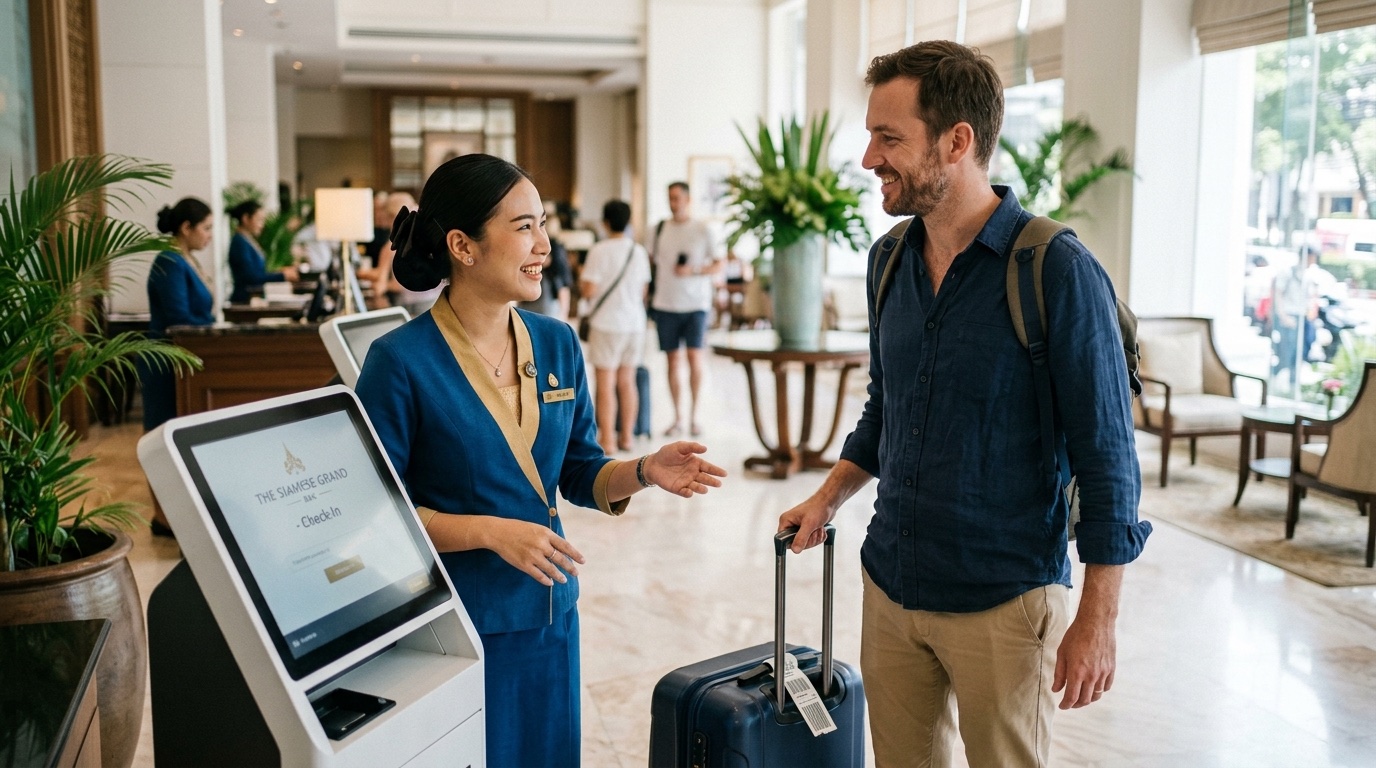
Ask a Thai hotelier why they're still hesitant about self-check-in, and the answer is rarely about cost or technology—it's about the welcome. The concern is genuine and specific: a guest who checks in via a kiosk or an app skips the moment where a receptionist greets them, learns their name, and sets the tone for the stay. It's the kind of objection that sounds like it's protecting the guest experience. A 2025 survey of American travelers suggests it's protecting the wrong thing.
The survey, run by Talker Research and commissioned by hotel-technology firm Mews, found most travelers actively prefer to skip the front desk when given the choice—and the preference is strongest among the youngest travelers, the exact demographic hoteliers worry most about disappointing. It sounds like data that confirms the personal-touch fear. It actually points somewhere else entirely: guests aren't rejecting human interaction, they're rejecting a specific, low-value version of it—the wait, the form, the repeated request for the same information. This piece walks through what the 2025 survey data actually shows, what "personal touch" should mean once the check-in queue stops being where it happens, and what a hotel actually needs to do differently to make that redirection real instead of just a talking point.
Guests aren't asking hotels to keep the front-desk queue—they're asking for the human moments to move somewhere more useful than a check-in form.
What Guests Actually Told Researchers in 2025
The Talker Research survey, fielded in late April and early May 2025 across 2,000 American travelers, found 70% would use an app or kiosk to check in rather than go through the front desk, rising to 82% among Gen Z travelers specifically. The same survey found 93% of respondents were willing to share personal data if it meant a more customized stay. Read together, those two numbers describe a traveler who isn't trying to avoid a hotel's attention—they're trying to avoid the specific, repetitive part of arrival that doesn't feel personal at all: standing in a queue to hand over a passport and confirm details that were already submitted at booking.
That's the piece of the personal-touch objection that doesn't hold up under the data. The front-desk queue was never actually the personal touch. It was the administrative gate a guest had to get through before any personal touch could happen.
The Empowerment Reframe: Why Self-Check-In Is Addition, Not Subtraction
Mews's founder, discussing the survey findings, framed the shift specifically as being "about empowering both guests and staff to create more meaningful touchpoints." That reframe matters more than it might first sound like it does. It repositions self-check-in from a subtraction (removing a human interaction) to a redistribution (moving staff attention away from an administrative task and toward moments that actually benefit from a human being present)—a distinction covered in more operational depth in the 2026 guide to automating hotel arrival steps without losing the welcome. A guest arriving late after a long flight doesn't need a receptionist keying in a room number they already confirmed online. They might genuinely benefit from a staff member with the bandwidth to notice they look exhausted and quietly offer a late checkout the next day, or answer a real question about the neighborhood instead of processing a form.
Why 93% Willing to Share Data Matters More Than the Front-Desk Number
The data-sharing figure is arguably the more important one for hotels to sit with, because it signals appetite for something hotels generally aren't set up to deliver yet: personalization built on more guest information, not less. A guest willing to share more data for a more customized stay is making an implicit trade—more information, in exchange for a hotel actually using it well. That trade only works in a guest's favor if the hotel handling that data is doing so responsibly, which is precisely the gap Thailand's 2025 PDPA enforcement cases against outsourced hotel-adjacent vendors show hotels can't afford to treat casually. Self-check-in collects and transmits more guest data than a front-desk form ever did, through more systems—which makes the vendor and data-handling discipline behind it part of the personal-touch conversation, not a separate compliance footnote.
Picture a hypothetical private clinic called Ruen Health, which introduced self-service check-in kiosks for returning patients a few years ago. The clinic didn't lose its bedside manner—it moved it. Nurses who used to spend the first ten minutes of every visit re-confirming insurance details and medical history now spend that time on the part of the visit that actually needs a trained human: listening to what's changed since the last appointment. The kiosk didn't replace the personal touch. It relocated it to the part of the interaction where it was actually doing something.
The Personal Touch Playbook
- Name the Moments Worth Protecting — decide explicitly which arrival moments genuinely need a human (a VIP welcome, a special-occasion stay, a guest with a complex request) rather than defaulting every arrival through the same manual process.
- Redirect Freed Time, Don't Just Free It — freed-up front-desk capacity only becomes a better guest experience if it's deliberately pointed at something, whether that's proactive local recommendations or faster response to in-stay requests.
- Train for Judgment, Not Just for the Old Process — staff whose routine data-entry work has moved to self-check-in need training on the higher-judgment moments they're now freed to handle, not just permission to do less.
- Treat Data-Sharing Willingness as a Responsibility, Not Just an Opportunity — guests who share more information for a more customized stay are trusting a hotel to handle it well; that trust needs a real data-governance answer behind it.
Redirection: what this all comes down to
If there's one word for what the 2025 survey data actually shows about self-check-in, it's Redirection—not the removal of a human touch, but the relocation of it to a moment that actually deserves one.
So here's the question worth sitting with: if self-check-in freed up an hour of front-desk time at your property tomorrow, do you already know exactly what you'd redirect that hour toward—or would it just quietly disappear into the rest of the shift?
FAQ
Does self-check-in data actually show guests want less human interaction at hotels?
No. The 2025 Talker Research survey found most travelers prefer to skip the front-desk process specifically, not human interaction generally—93% were willing to share more personal data in exchange for a more customized stay, which points toward wanting more relevant human attention, not less.
Which travelers are most likely to prefer self-check-in?
Gen Z travelers showed the strongest preference in the 2025 survey, at 82% choosing an app or kiosk over the front desk, compared with 70% across all respondents.
Does self-check-in save labor cost, or just redirect labor?
The survey data speaks to guest preference, not cost savings directly—but the practical effect for a hotel is freed staff capacity, which only becomes a guest-experience benefit if it's deliberately redirected rather than left unassigned.
Is collecting more guest data for personalization a PDPA risk?
It can be, if the systems handling that data aren't properly governed. The same due-diligence and vendor-oversight standard covered in Thailand's 2025 PDPA enforcement cases applies directly to whatever platform is collecting and storing guest preference data for personalization.
Do guests still want a warm welcome at check-in even with self-check-in available?
Yes—the survey data doesn't suggest guests want a cold arrival. It suggests they want the administrative parts of arrival handled efficiently so that any human interaction that does happen is actually meaningful, not a formality.
What this looks like with NAWA Hotel
NAWA Hotel's front office brings reservations, guest details, and check-in/check-out into one connected system, so the administrative side of arrival doesn't need to run through a manual, repetitive front-desk process. That's the operational foundation that makes redirecting staff attention toward higher-value guest moments possible in the first place, rather than just a plan on paper.
If you want to map out where your front-desk team's time actually goes today, talk to us about your current check-in workflow.
Sources: Mews (Talker Research survey of 2,000 US travelers, April–May 2025), "The Rise of Self-Check-In Hotels"