

You know the moment. Three guests arrive together, the phone rings, one room is still marked dirty, and somebody is searching for the spreadsheet that was definitely updated five minutes ago.
Thailand welcomed more than 14 million international visitors by 2 June 2026, and the Tourism Authority of Thailand (TAT) is targeting 33 million for the full year—while pushing a "Value over Volume" strategy that prizes quality experiences over raw arrival numbers. Krungsri Research's January 2026 industry outlook forecasts nationwide hotel occupancy at 72.0% for the year, with Bangkok, Chonburi, and Phuket expected to clear 75%. More guests, at fuller hotels, with an official mandate for a better experience—not a faster, cheaper one.
It sounds like a hardware decision: which kiosk, which app, which vendor demo was the most polished. It is actually a workflow decision—which arrival steps are predictable enough to hand to a screen, and which ones still need a person standing there to notice that something is wrong.
This guide walks through what self-check-in actually means, the three models independent Thai hotels are choosing between, how to design one guest journey that satisfies TM30 and PDPA, and a way to think about ROI before you buy anything.
Automate the predictable arrival steps. Keep your team free for the moments that need real judgment.
What hotel self-check-in actually means
Self-check-in allows a guest to complete some or all arrival steps without waiting for a receptionist to manually process every field.
Depending on the hotel, the journey may include:
- Confirming the reservation.
- Entering or checking guest details.
- Scanning a passport or identification document.
- Reviewing the privacy notice and hotel policies.
- Making or confirming payment and deposit arrangements.
- Signing a registration form.
- Receiving a room number, key card, PIN, or digital key.
- Getting Wi-Fi details, breakfast times, directions, and support information.
Self-check-in is not one product format. An independent hotel can offer it through a guest's phone before arrival, a tablet or kiosk in the lobby, or a hybrid flow combining digital preparation with a short human welcome. The best option is the one that fits your guests, building, staffing model, PMS, door locks, payment process, and appetite for operational change.
Why independent hotels are considering it in 2026
Large hotel groups can spread technology investment across many properties. Independent operators have less room for expensive mistakes, but they also feel operational friction more directly.
Self-check-in may be worth exploring when:
- Guests often arrive in waves or after normal reception hours.
- Staff repeatedly type information already present in a booking.
- Check-in queues regularly form during peak periods.
- Receptionists spend more time processing forms than welcoming guests.
- Owners cannot easily see incomplete registrations, unpaid balances, or exceptions.
- Growth would otherwise require adding repetitive administrative work at the same rate as arrivals.
A 2025 study in the journal *Discover Sustainability* on smart hotel technologies in Thailand found that intelligent operations and contactless, technology-supported experiences meaningfully improved guest satisfaction, which in turn predicted word of mouth and revisit intentions. That does not mean every guest wants a fully automated stay. It means technology should improve the experience guests came for, not just remove a job from the payroll.
Convenience matters. So does knowing that a real person can help when the booking name does not match the passport, the payment fails, or a tired family arrives with questions the kiosk was never trained to answer.
The three practical self-check-in models
Mobile pre-arrival check-in. The hotel sends a secure link before arrival. The guest completes the predictable steps on their own phone and receives clear instructions about what happens next. This suits guests who prepare before travelling and hotels with limited lobby space, but success depends heavily on message timing, mobile usability, language, and a simple fallback for guests who don't finish.
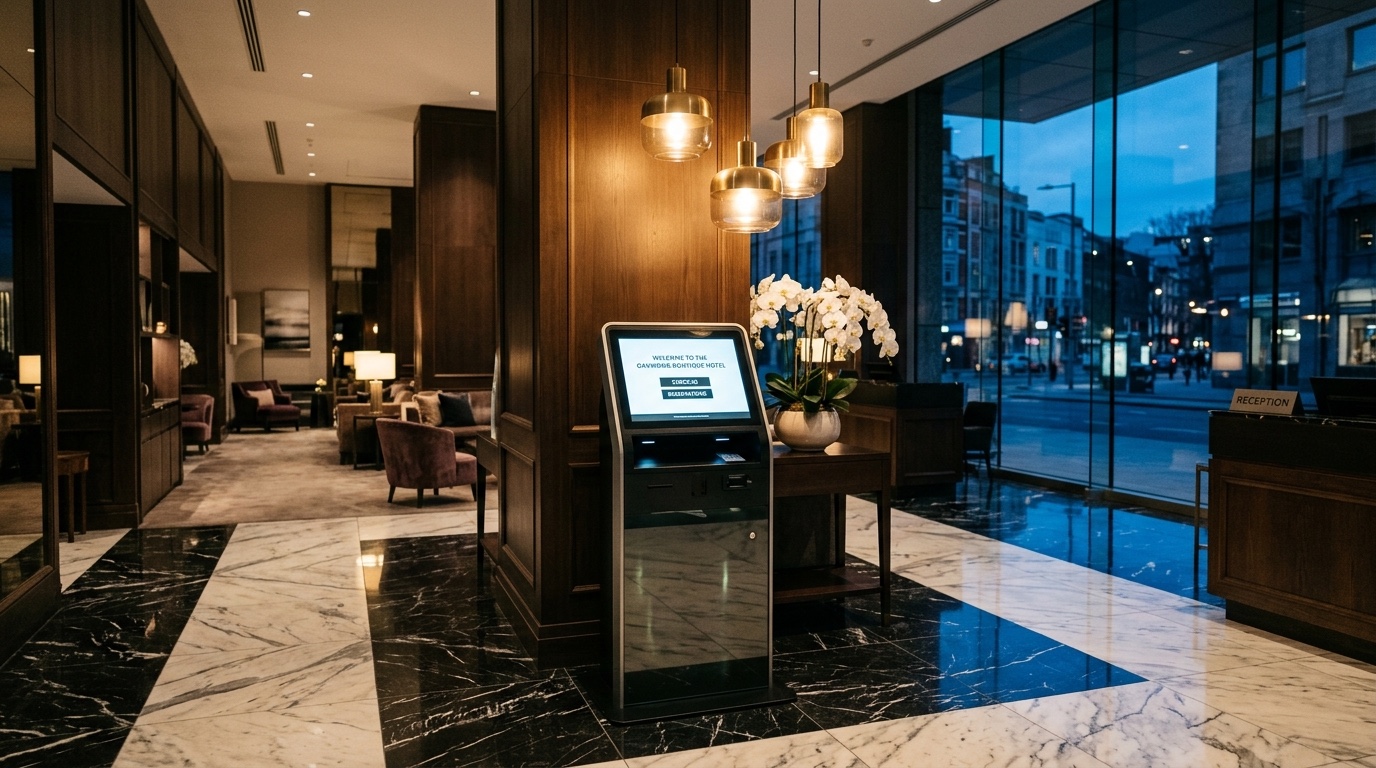
Lobby kiosk or tablet check-in. The guest completes the flow on hotel-provided hardware after arrival. This can suit hotels with steady arrival volume, 24-hour access needs, or guests unlikely to finish a pre-arrival message—but it introduces hardware, maintenance, placement, and connectivity considerations. A kiosk that is "temporarily unavailable" every Saturday night becomes an expensive lobby decoration.
Hybrid self-check-in. The guest completes repetitive steps digitally, while staff handle exceptions and offer a human welcome. For many independent Thai hotels, this is the sensible starting point—it reduces queues and typing without pretending hospitality is an obstacle to efficiency.
We break these three down in far more detail, including a full cost and fit comparison, in our side-by-side look at kiosk versus mobile check-in.
The Predictable-Exceptional Split: what actually belongs to a screen
Most self-check-in projects go wrong at the same point: someone asks "which kiosk should we buy" before anyone has asked "which of our eight arrival steps are actually predictable, and which ones require a person's judgment."
Call this the Predictable-Exceptional Split. Steps like confirming a reservation, entering already-known guest details, or presenting a standard registration form are predictable—the same inputs produce the same correct output almost every time. Steps like a booking name that doesn't match a passport, a family with a special request, or a payment that fails twice are exceptional—they need someone empowered to make a judgment call, not a form that forces a confident-looking wrong answer.
A strong guest journey treats these differently at every stage: confirm the reservation without forcing a long code if a secure link can identify it; explain what's needed and why; collect only necessary information; verify identity and occupancy but flag uncertain cases for staff review rather than letting software guess; show payment and deposit terms clearly; make policies readable on a phone, not a twelve-page wall of text; release room access only once required checks are complete; and keep a staffed contact visibly available throughout, not hidden in a footer.
Once you can point at each of those eight steps and say "predictable" or "exceptional," you already know roughly what a self-check-in flow should automate—and what it should still route straight to a person.
Thailand requirement: plan for TM30
Under Section 38 of Thailand's Immigration Act, a hotel manager or accommodation provider receiving a foreign national must notify the local immigration authority within 24 hours of arrival. The Immigration Bureau's TM30 online system supports individual notification and importing the required spreadsheet format. Thailand Immigration Bureau: TM30 online system
This affects self-check-in design because the arrival flow may collect information also required for the hotel's notification process, including passport and stay details. Before selecting a system, ask which TM30-related fields are captured, whether authorized staff can review information before submission, whether the system exports the currently accepted format, and who remains responsible for checking and submitting the notification.
Do not assume a vendor has a direct government API connection. Ask for a live demonstration and verify what "TM30 ready" actually means. Sometimes it means a helpful export. Sometimes it means someone added the letters T, M, and 30 to a sales slide. Regulations and government-system procedures can change—verify current requirements with Thailand Immigration or qualified local counsel before implementation.
Thailand requirement: protect guest data under PDPA
Names, passport details, phone numbers, signatures, payment records, and stay information can be personal data. A self-check-in system concentrates this information, which makes privacy and security part of the guest experience.
ETDA's PDPA resources confirm that identifiable information such as names, addresses, phone numbers, and email addresses is personal data, and that certain categories require additional care. ETDA: Personal Data Protection Act overview A practical review should cover the purpose and legal basis for each field collected, a clear privacy notice in the languages your guests actually read, access permissions across reception and vendors, encryption and retention rules, and procedures for data-subject requests and incidents. Do not collect extra passport images "just in case." More data is not automatically more control—sometimes it is simply more information available to lose. We cover this in full, field by field, in our PDPA, passport data, and TM30 checklist for digital check-in.
The integrations that determine whether it saves time
The guest-facing screen receives most of the attention. The integrations behind it—PMS, booking engine, payments, door locks, guest messaging, and a staff exception dashboard—determine whether the team actually saves work or just moves the same manual reconciliation somewhere less visible. For the full blueprint, see how to connect self-check-in with your PMS, smart locks, payments, and LINE.
Picture a hypothetical 36-room boutique hotel in Hua Hin called Baan Rak Talay—a fictional property, not a real NAWA client. Before touching a kiosk or an app, Baan Rak Talay's manager spent one week timing its own front desk: of the eight arrival steps, five (reservation match, guest details, standard registration, policy acknowledgement, Wi-Fi and directions) were genuinely predictable and accounted for roughly 70% of a receptionist's per-arrival time. The other three—identity mismatches, payment exceptions, and room-not-ready cases—were rare but consumed a disproportionate share of stress and queue time. That single week of measurement, not a vendor brochure, is what told Baan Rak Talay to start with mobile pre-arrival check-in for the predictable five and keep every exceptional case with a person.
A practical 30-60-90 day implementation plan
Days 1-30: map and prepare. Record the current arrival journey from confirmation to room access. Count arrival volume, processing time, exceptions, and failure points. Identify required data and remove unnecessary fields. Document PMS, payment, lock, messaging, and TM30 workflows. Review PDPA responsibilities with qualified advisers, and define who owns the project.
Days 31-60: configure and test. Build the shortest workable guest flow. Configure Thai and English first; add other languages based on real guest mix. Test normal bookings, OTA bookings, room moves, shared rooms, late arrivals, failed payments, and lost access credentials. Train staff on assistance and exception handling.
Days 61-90: pilot and improve. Start with selected room types, arrival windows, or willing guests. Keep the traditional option available during the pilot. Review completion, assistance, error, and guest-feedback data weekly. Fix the largest point of friction before adding more features.
The first goal is not maximum automation. It is a dependable arrival experience.
The Predictable-Exceptional Playbook
- Time Before You Buy — measure your current arrival steps for at least a week before choosing hardware, the same way Baan Rak Talay did, so the Predictable-Exceptional Split is based on your numbers, not a vendor's pitch.
- Route, Don't Remove — every exceptional case needs a visible, staffed route, not a dead end inside a kiosk menu.
- One Owner Per Field — for every piece of data the flow touches, name the one system or person responsible for it being correct.
- Reuse the Split Elsewhere — the same predictable-versus-exceptional lens applies outside the front desk; a spa counter booking treatments can automate slot confirmation and deposit collection while still routing a guest with a skin allergy or a rescheduling dispute straight to a therapist who can actually judge the situation.
Predictable: the one word this comes down to
If there's one word for what makes self-check-in work, it's Predictable—not the technology, not the hardware brand, just an honest map of which arrival steps genuinely repeat the same way every time.
So here's the question worth sitting with: if you timed your own front desk for one week starting tomorrow, do you already know which of your eight arrival steps would land on the predictable side—or would you be surprised?
Frequently asked questions
Will self-check-in replace our reception team?
It does not have to. Independent hotels often get more value by moving repetitive work away from staff and keeping people available for exceptions, advice, recovery, and genuine hospitality.
Do we need a kiosk?
No. Mobile pre-arrival check-in may be enough for some properties. A kiosk becomes more useful when guests need on-site hardware, visible after-hours access, key-card encoding, or an alternative to mobile completion.
Can self-check-in handle TM30 automatically?
Do not assume it can submit directly to Immigration. A system may capture required information and prepare an export, while authorized hotel staff remain responsible for checking and completing the official process. Verify the vendor's current capability and current Immigration procedure.
Is passport scanning PDPA compliant?
Compliance depends on why and how data is collected, used, stored, shared, protected, and deleted. Passport scanning is not automatically compliant or non-compliant. Review the exact process and legal basis with qualified Thai counsel or a privacy professional.
What should we automate first?
Start with the predictable steps that consume time and have clear rules: reservation confirmation, guest-detail review, standard registration, payment confirmation, policy acknowledgement, and arrival instructions. Keep uncertain decisions with trained staff.
The next sensible step
Self-check-in should not make an independent hotel feel less human. It should give the team more time to notice the guest who needs help, recommend the right local experience, solve a problem before it becomes a review, and deliver the welcome that technology cannot imitate.
NAWA already has a dedicated hotel self-check-in product built around exactly this: one branded pre-arrival link, and a single integration map covering PMS, payments, identity, messaging, and room access. Before you buy separate hardware, talk to us about your current arrival workflow—we'll help you map which of your steps are genuinely predictable, and where automation would (and would not) help.
Sources reviewed
- Tourism Authority of Thailand: Thailand Tourism Update at TTM+ 2026
- Krungsri Research: Hotel Business Industry Outlook 2026-2028
- Thailand Immigration Bureau: TM30 online system
- ETDA: Personal Data Protection Act overview
- Discover Sustainability: Investigating the role of smart hotel technologies in enhancing guest experiences and sustainable tourism in Thailand
Information and links were reviewed on 12 August 2026. This article provides general operational information, not legal advice.