

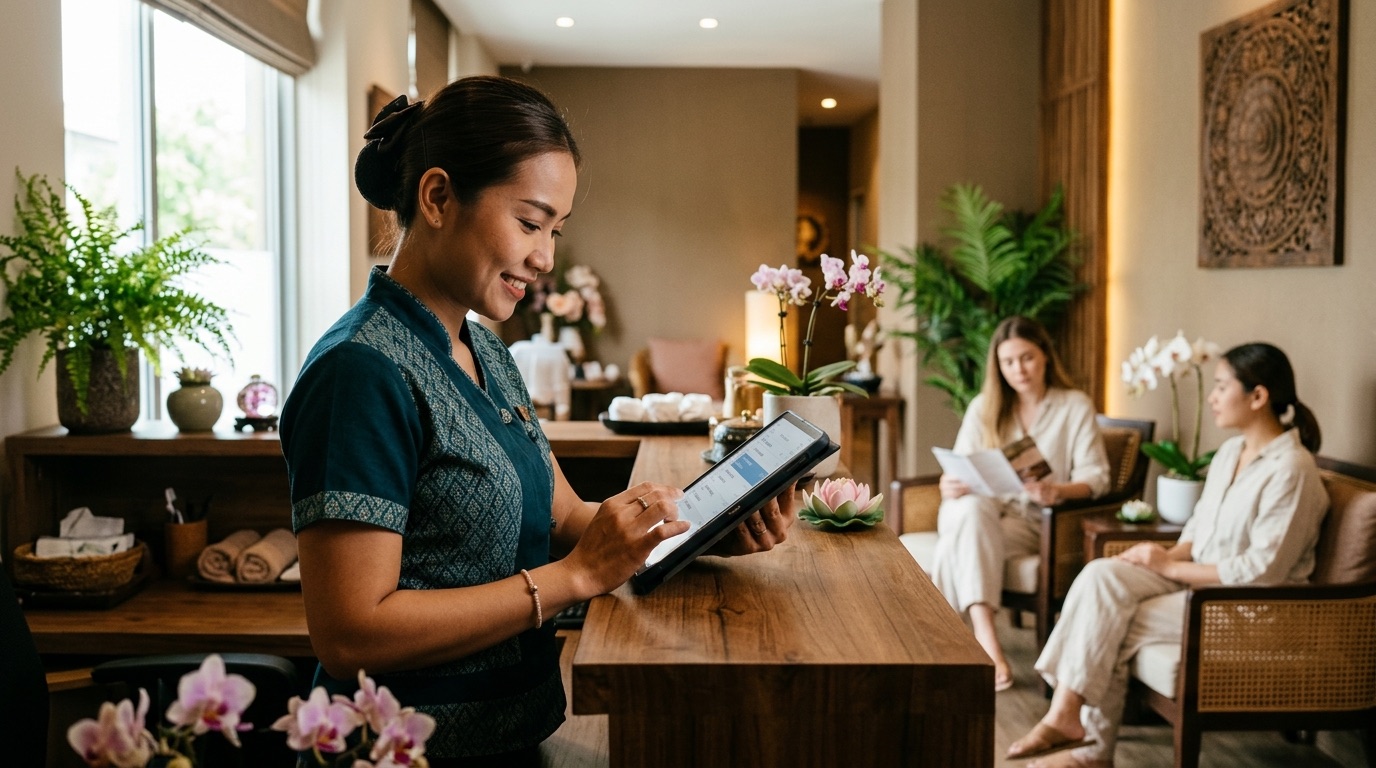
Two customers arrive at 2:00 p.m. for the same therapist. One booked through the website that morning. The other booked through Instagram the day before. Both received a confirmation. Both are standing at the counter now, and only one of them is getting the appointment they were promised. Thailand's wellness economy grew from $38.8 billion in 2023 to $42.7 billion in 2024, with the spa sector alone growing 18% a year, according to the Global Wellness Institute's February 2026 data release—and every extra booking that growth brings in is another chance for two channels to promise the same slot.
More booking channels isn't the risk—more booking channels without one shared schedule behind them is.
It sounds like the answer is cutting back on booking channels to reduce the collision points. It isn't—customers book where they already are, and closing a channel just moves the lost booking somewhere else. This piece covers why more channels genuinely raises the risk, exactly where the collision happens, and what actually stops it without asking a single customer to book differently.
Phantom Availability: The Slot That's Already Gone but Still Shows Open
Every additional booking channel is genuinely good for customer convenience—people book where they already are, whether that's your website, Instagram, LINE, or the front desk. The risk isn't the number of channels. It's Phantom Availability: a slot that still shows as open on one channel for minutes or hours after it's already been taken through another, because neither channel checked the same real-time truth before confirming.
A spa taking bookings through one channel rarely sees Phantom Availability, because there's only one place availability can be checked and confirmed. The moment a second channel is added, the question becomes whether both channels are reading from and writing to the same schedule, or working from two separate pictures that only get reconciled when someone notices a conflict. The same one-place-to-check advantage disappears in exactly the same way when a spa opens a second branch—see why stock tracking that worked fine at one location breaks down once there's a second one for the inventory version of this same problem.
Where the collision actually happens
It's rarely the channels themselves that are at fault—it's the gap between when a customer requests a time and when that request is actually checked against current availability. A same-day website booking system checking live availability is safe. A same-day website booking plus a same-day Instagram DM being confirmed by two different staff members within minutes of each other, without either checking the other's channel first, is where the collision happens.
Picture a hypothetical spa called Bua Luang Spa, a mid-size Bangkok spa taking bookings through its website, Instagram, LINE, and the front desk. On an average week, Bua Luang's four channels rarely collided—demand was low enough that gaps covered the mistakes. During a long-weekend surge, three separate staff members were confirming bookings at once, each looking at their own channel, and by Sunday evening the schedule showed nine phantom slots that had already been double-promised.
What actually prevents this
The fix isn't reducing the number of channels customers can use—it's making sure every channel checks and books against the same live schedule, so a slot confirmed on Instagram at 10:00 a.m. is already unavailable on the website at 10:01. This also solves a second, quieter problem: without a shared schedule, staff have no reliable way to see a therapist's real workload across all channels, which makes fair scheduling and break planning harder than it needs to be. That same real-time picture of who actually got booked where is also the foundation for calculating therapist commissions correctly, since commission has to be based on the appointments that actually happened, not just who was scheduled.
The Phantom Availability Playbook
- One Live Truth — every channel reads and writes to the same real-time schedule, so a slot taken anywhere disappears everywhere at once.
- No Manual Reconciliation — availability is never "checked later against the book"; it's checked at the moment of confirmation, every time.
- Staff Workload Visibility — every staff member scheduling a booking can see a therapist's full day across all channels, not just their own.
- Surge-Period Review — after any high-demand weekend or holiday, review confirmed bookings against the schedule to catch collisions before they repeat.
A hair salon running the same mix of website, Instagram DM, and walk-in bookings hits the identical Phantom Availability problem on a busy Saturday—the fix is the same shared, real-time schedule, regardless of what's in the chair.
Single Schedule: what this all comes down to
If there's one word for what actually prevents double bookings across channels, it's Single Schedule—not fewer channels, not stricter booking rules, just one place where "available" means the same thing no matter who's asking.
So here's the question worth sitting with: the next time two staff members confirm a booking within minutes of each other, are they both looking at the exact same schedule, or two different ones that just happen to look similar? If you're not sure, that's where your next double booking is already forming.
FAQ
Does adding more booking channels always increase the risk of double bookings?
Only if the channels aren't checking the same real-time schedule. A spa with four channels feeding one shared calendar is safer than a spa with two channels feeding two separate ones.
Is Phantom Availability worse for busy spas or quiet ones?
Busy spas and surge periods make it worse, since more bookings are being confirmed closer together in time—but any spa with more than one channel and no shared schedule is exposed.
How quickly does a confirmed booking need to update across channels?
Effectively immediately. A gap of even a few minutes during a high-demand period is enough for two staff members to confirm the same slot.
Does fixing this require training customers to book differently?
No. The fix happens entirely behind the scenes—the customer keeps booking through whichever channel they already prefer.
What this looks like with NAWA Spa
NAWA Spa lets customers book through your website, Facebook and Instagram Messenger, LINE OA, or walk-in, with every channel reading from and writing to the same real-time schedule for rooms, staff, and resources. A booking confirmed through one channel is immediately reflected everywhere else, so the front desk, your social media booking, and your website are always working from the same picture of what's actually available.
If double bookings across channels are a recurring headache at your front desk, talk to us about how your booking channels currently work together.