

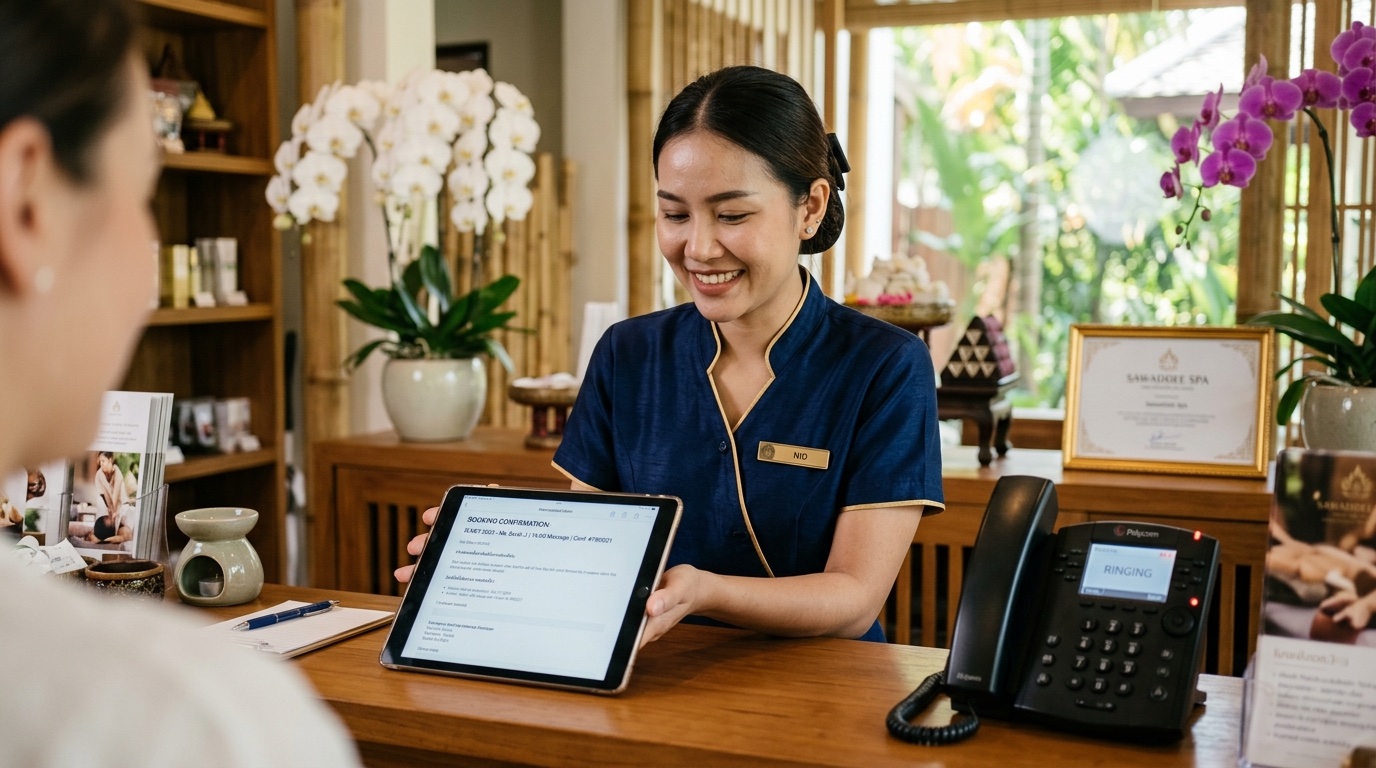
The same week, two customers walk into the same spa. One is a 58-year-old regular who calls the front desk directly, the way she's booked every appointment for the past three years. The other is a 27-year-old visitor from Germany who found and booked the spa entirely through a booking app the night before, without speaking to a single staff member until she walked through the door. It sounds like a simple generational story—younger customers book online, older ones call. The actual data is sharper than that: a 2025 Thai Spa Association survey found that 63% of international spa clients under 35 booked their first appointment online, a specific, measurable segment rather than a vague generational trend. This piece covers what that survey actually found, what it costs a spa to let a third party capture that segment instead of doing it directly, and what the domestic side of the same booking story looks like.
The booking behavior gap isn't between online and offline—it's between the spas capturing under-35 international demand directly and the ones paying 15-20% for someone else to capture it for them.
What the 2025 Survey Actually Found
According to reporting on the Thai Spa Association's 2025 survey, 63% of international spa clients under 35 had booked their first appointment at a Thai spa online. That's a specific, named segment—international, under 35—not a claim about Thai spa customers in general. The same reporting names a Chulalongkorn University researcher, Dr. Krit Pongpanich, who studies tourism economics, as a source tracking the tension this creates within the industry.
The Aggregator Tax: What Spas Pay for Not Booking Guests Direct
The same reporting cites operator accounts of third-party aggregator platforms charging 15% to 20% commission per booking, using a 1,500 baht massage as the reference price point. Run the math the way an operator would at the register: at 15% commission, a spa keeps 1,275 baht of that 1,500 baht booking and pays 225 baht to the platform. At 20%, the spa keeps 1,200 baht and pays 300 baht. Call that the Aggregator Tax: not a fee for nothing, since the platform is genuinely delivering a customer the spa might not have reached otherwise, but a cost that applies specifically to the segment—under-35, international, comfortable booking online first—that a spa's own website or booking channel could capture directly if it offered the same ease. Every booking from that segment that lands on an aggregator instead of a direct channel is 225 to 300 baht, on a 1,500 baht service, quietly leaving the business. Capturing that booking directly only helps if it lands on a schedule that can actually hold it—see why more booking channels raise the risk of double bookings without one shared schedule behind them for what has to be true before adding a direct channel is a net win rather than a new collision point.
Why "Just Show Up" Isn't Actually the Whole Domestic Story Either
The same reporting captures a cultural instinct worth naming honestly: Dr. Krit Pongpanich is quoted describing part of the Thai spa experience as walk-in and word-of-mouth—"you just show up and everything flows naturally"—a real observation about how many domestic customers have historically approached booking a spa visit. That instinct isn't wrong for the customers who still operate that way, and nothing about the 63% online-booking figure for under-35 international clients requires forcing a loyal, decades-long domestic customer to change how she's always booked. The two behaviors—show-up-and-flow for one segment, book-ahead-online for another—coexist inside the same spa, on the same day, and the mistake is designing a booking system for only one of them.
Picture a Spa Watching Both Behaviors at Once
Picture a hypothetical business called Nara Spa House, where the owner started actually tracking how each booking arrived rather than assuming she already knew. Older Thai regulars almost universally called the front desk directly, exactly as expected. Younger international guests almost universally arrived having booked through a third-party platform the night before—not because Nara Spa House lacked a website, but because the platform's booking flow was faster and more familiar to a traveler already using it to find restaurants and tours. What the owner hadn't done until then was calculate what she was actually paying in commission on that international volume, or consider that a direct booking option, made just as easy, could keep that same 225 to 300 baht per booking in the business instead. It also made her rethink LINE, the channel most of her domestic regulars actually messaged through—see why LINE bookings still get lost even when the channel itself is exactly where customers already are for the domestic-side version of the same capture problem.
The Aggregator Tax Playbook
- Segment Your Booking Channels by Who's Actually Using Them — track bookings by channel and, where possible, by customer type, rather than assuming "online bookings" is one undifferentiated group.
- Calculate What the Commission Actually Costs on Your Real Volume — 15-20% per booking adds up differently depending on how much of your revenue is already flowing through aggregator platforms; know the real number before deciding whether to change anything.
- Give the Under-35 International Segment a Direct Option That's as Easy as the Aggregator — the survey data says this segment already books online readily; the opportunity is making your own channel just as fast, not convincing them to call instead.
- Don't Force Domestic Regulars Off Habits That Already Work — a phone call or a LINE message that's worked for years isn't a problem to fix just because a younger, international segment behaves differently.
A boutique hotel faces the identical math with online travel agency commissions on room bookings—the guest who'd happily book direct if the process were just as fast is exactly the guest an aggregator is currently getting paid to deliver. NAWA has written about that version of the same problem in the economics of direct bookings versus OTA commissions, and the underlying math is nearly identical to a spa's own aggregator commission question.
Capture: what this all comes down to
If there's one word for what this survey data actually reveals, it's Capture—not whether your customers book online or by phone, but whether your own booking channel is capturing the segment that already wants to book online, or letting a 15-20% commission capture it instead.
So here's the question worth sitting with: for the last ten international bookings under 35 your spa took, do you know how many came through your own channel versus a commissioned platform—and if you don't, what would it take to find out?
FAQ
What did the 2025 Thai Spa Association survey actually find?
That 63% of international spa clients under 35 booked their first appointment at a Thai spa online—a specific finding about that segment, not a general claim about all Thai spa customers.
How much commission do spa booking aggregator platforms typically charge?
Reporting on the survey cites operator accounts of 15% to 20% commission per booking, using a 1,500 baht massage as the reference price—meaning 225 to 300 baht of that booking goes to the platform rather than the spa.
Does this mean every spa needs its own online booking system?
Not automatically—but the data suggests a spa with a strong under-35 international customer base is leaving direct-booking revenue on the table if its own booking process isn't as fast and easy as a third-party platform's.
Is the domestic Thai customer base moving toward online booking too, or mostly still calling or messaging?
The cited survey specifically measured international clients under 35; the reporting also describes a long-standing walk-in, word-of-mouth booking culture among domestic customers that coexists with, rather than gets replaced by, the online-booking behavior of younger international visitors.
What's the real cost of staying dependent on aggregator platforms?
Based on the cited commission rates, 15% to 20% of every booking made through that channel—money that a spa capable of offering an equally easy direct-booking option could otherwise keep.
What this looks like with NAWA Spa
NAWA Spa lets customers book through your website, Facebook and Instagram Messenger, LINE OA, or walk-in—all landing on the same real-time schedule. That means the under-35 international segment that already prefers booking online has a direct channel just as fast as a third-party aggregator, without your regulars who call or message having to change a habit that already works for them.
If you want to see how much of your booking volume is currently going through commissioned channels versus your own, talk to us about your current booking setup.
Sources: Chiang Rai Times, "How Thailand's Wellness Industry Is Going Digital In 2026," July 2026